


Hair Fall in Men: Why It Happens and What Can Be Done
Hair fall in men — male pattern baldness, causes, and what treatments actually work. Guide from Prakash Hospital Noida, Noida.
7 Sept 2026
by Prakash Hospital
by Prakash Hospital

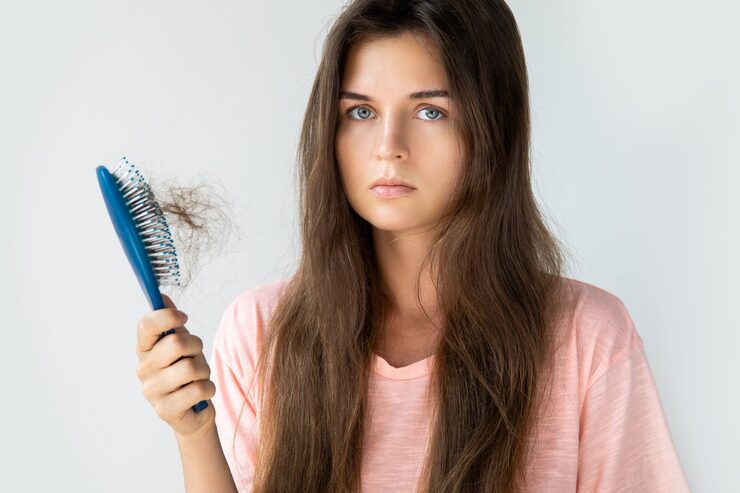
Concerned woman holding a hair brush full of falling hair, indicating thinning hair among perimenopause symptoms.
Hair fall in women is fundamentally different from hair fall in men — not just in pattern, but in the causes that drive it. While male hair loss is dominated by androgenetic alopecia (genetic pattern baldness from DHT), female hair loss is shaped by a complex interplay of hormones, nutritional status, reproductive health, and life stage transitions that are unique to women.
The result is that the same investigation approach doesn't apply to both sexes. A woman presenting with hair thinning needs evaluation that goes well beyond what a man with the same complaint would require.
Women rarely develop the receding hairline and crown baldness typical of male pattern hair loss. Instead, female hair loss most commonly presents as:
These patterns don't typically progress to complete baldness — an important reassurance for most women experiencing hair loss — but they can be distressing and affect self-esteem significantly.
Iron deficiency (even without anaemia) is the most common correctable cause of hair fall in Indian women. The statistics are stark: iron deficiency anaemia affects an estimated 50–60% of Indian women of reproductive age, and many more have low serum ferritin (iron stores) without overt anaemia.
Hair follicles are among the most metabolically active cells in the body — they need a constant supply of oxygen and nutrients delivered by red blood cells. When iron stores are low, the follicle's metabolic activity is reduced, the growth phase shortens, and hairs enter the resting phase early.
The critical point: standard haemoglobin testing is insufficient. A haemoglobin value in the lower-normal range can coexist with serum ferritin below 30 ng/mL — the threshold below which hair loss becomes significant. Any woman with unexplained hair thinning should have her serum ferritin measured specifically.
Iron replacement with supplementation (ferrous bisglycinate is gentlest on the stomach) and increased dietary iron (rajma, masoor dal, eggs, drumstick leaves, ragi) combined with vitamin C for absorption typically produces hair recovery over 3–6 months.
One of the most commonly experienced yet most anxiety-provoking forms of hair loss in young women. After delivery, the dramatic fall in estrogen causes a large proportion of hair that was "locked" in the growth phase during pregnancy (high estrogen keeps hairs in the growth phase) to simultaneously enter the resting phase.
Two to three months after delivery, mass shedding begins — and can be alarming in its apparent severity. This is telogen effluvium, and it is almost always self-limiting. Hair typically begins regrowth at 3–6 months postpartum and returns to normal density by 12 months in most women.
What helps recovery:
Postpartum hair loss does not require aggressive treatment. What it requires is nutritional support and reassurance.
Polycystic ovarian disorder (PCOD) is among the most common causes of hair thinning in women of reproductive age in India, affecting 20–25% of urban Indian women. The mechanism is androgen excess.
Women with PCOD produce more testosterone and DHEAS than women without the condition. These androgens interact with hair follicles genetically predisposed to respond to them, causing follicle miniaturisation — the same mechanism as male pattern baldness, but typically less severe and more diffuse in women.
The characteristic pattern: thinning at the crown and top of the scalp (the areas most sensitive to androgen), sometimes with a preserved hairline. Often accompanied by the seemingly paradoxical combination of scalp hair loss plus increased facial or body hair (hirsutism) from the same androgens.
Any woman with the combination of scalp thinning and unwanted facial hair deserves investigation for androgen excess and PCOD — a hormonal panel (testosterone, DHEAS, LH, FSH) alongside blood sugar and insulin.
Treatment targets the underlying PCOD: insulin sensitisers (metformin), anti-androgen medications (spironolactone, cyproterone acetate), oral contraceptive pills with anti-androgen properties, and lifestyle changes that reduce insulin resistance.
Both hypothyroidism and hyperthyroidism cause hair loss in women, and thyroid disorders are significantly more common in women than men.
Hypothyroidism: diffuse hair thinning, dry brittle hair, and a specific sign — loss of the outer third of the eyebrows (lateral eyebrow thinning). Accompanied by fatigue, weight gain, cold sensitivity, constipation, and menstrual irregularity. Very common in Indian women, with Hashimoto's thyroiditis (autoimmune hypothyroidism) the most prevalent cause.
Hyperthyroidism: finer, more limp hair with diffuse thinning. Associated with weight loss, palpitations, heat intolerance, and irritability.
A simple TSH blood test identifies thyroid dysfunction. Hair loss from thyroid disease improves with appropriate thyroid treatment — but recovery can take 6–12 months after thyroid function normalises.
As estrogen declines during the years approaching menopause (typically 40s in India) and after it, several hair changes occur:
These changes are gradual but cumulative. Women who notice progressive thinning through their 40s are often experiencing the hormonal hair changes of perimenopause alongside the background of genetic predisposition.
Hormone replacement therapy (HRT) preserves hair during and after menopause for some women, though the risks and benefits must be individually assessed with a doctor. Topical minoxidil is appropriate for significant thinning.
Women are disproportionately affected by chronic stress — from the combination of work, household responsibilities, caregiving for children and elderly parents, and the psychological demands of these roles. Cortisol from chronic stress disrupts the hair growth cycle and can tip more follicles into the telogen phase.
Telogen effluvium from stress typically:
The cycle can become self-reinforcing: stress causes hair loss, which causes more stress, which perpetuates the hair loss. Breaking this cycle requires addressing the underlying stress alongside nutritional support.
Extreme restriction — crash diets, intermittent fasting taken to extremes, or disordered eating patterns — causes hair fall through multiple mechanisms: protein deprivation (hair is keratin), micronutrient deficiency (iron, zinc, B vitamins), and the physiological stress response to severe caloric restriction.
This is particularly relevant in young Indian women subject to social pressure to lose weight rapidly. The hair loss typically begins 2–3 months after the restrictive period and can be significant.
Gradual, sustainable weight loss with adequate protein avoids this. 0.5 kg per week with protein intake above 60g daily prevents most diet-related hair loss.
Several medications commonly used by women in India cause hair fall:
An autoimmune condition causing sudden patchy hair loss — smooth, round bald patches that appear over days. More common in people with other autoimmune conditions (thyroid disease, vitiligo) and those under significant stress. Affects both sexes equally.
Most patches regrow within 6–12 months, though the condition can recur. Dermatology evaluation is appropriate.
Blood tests:
Clinical evaluation:
At Prakash Hospital Noida, our physicians and gynaecologists evaluate hair fall in women with targeted blood tests, hormonal assessment, thyroid evaluation, and treatment of underlying causes. PCOD management, nutritional counselling, and dermatology referral are available.
Whether you live in Sector 18, Sector 62, Greater Noida West, or anywhere in the NCR, Prakash Hospital Noida is a trusted name for female hair fall, women's health, and hormonal care in Noida.
To book a consultation, call the number.
Tags: #HairFallReasonsInWomen #FemaleHairFall #PrakashHospitalNoida

This article covers skin and hair concerns. These Prakash Hospital doctors in Noida treat them.

Dr. Mohna Chauhan
Consultant Dermatologist & Cosmetic Surgeon
Dermatology · Cosmetic Surgery
Microneedling, laser, peels and minor procedures matched to your scar type to smooth pitted acne scars.
Laser light damages hair roots to reduce unwanted hair over 6 to 8 sessions, with settings matched to your skin.
A controlled acid solution lifts damaged surface skin to fade pigmentation, tanning and acne marks.
Free tools to check your weight, plan a pregnancy, track calories and more.
We offer expert care across key specialties, including Medicine, Cardiology, Orthopaedics, ENT, Gynaecology, and more—delivering trusted treatment under one roof.
Hair fall in men — male pattern baldness, causes, and what treatments actually work. Guide from Prakash Hospital Noida, Noida.
7 Sept 2026
by Prakash Hospital

Does dandruff cause hair fall? The link between scalp inflammation and hair loss — and how to treat both. Prakash Hospital Noida.
7 Sept 2026
by Prakash Hospital

Which vitamin deficiencies cause hair fall — iron, vitamin D, B12, and zinc. How to test and fix them. Prakash Hospital Noida.
4 Sept 2026
by Prakash Hospital

सीने में जलन (एसिडिटी) और हार्ट प्रॉब्लम के लक्षणों में क्या फर्क है? कब यह गंभीर हो सकता है और डॉक्टर से कब मिलना चाहिए, पूरी जानकारी हिंदी में।
23 Apr 2026
by Prakash Hospital

Practical ways to lower blood pressure naturally through diet, exercise, and lifestyle — plus when medication is needed. Prakash Hospital Noida.
5 Aug 2026
by Prakash Hospital

Learn symptoms, risk factors, prevention tips and when to seek expert cardiac care in Noida.
25 Mar 2026
by Prakash Hospital

Main reasons for hair fall in India — nutritional deficiency, hormones, stress, and more. What's causing yours and what to do. Prakash Hospital Noida.
1 Sept 2026
by Prakash Hospital
Oily skin causes in India, what makes it worse, and how to manage it with diet and skincare. Prakash Hospital Noida.
11 Sept 2026
by Prakash Hospital
Learn The 10 Best Things to Do for Your Hair to Prevent Hair Loss with expert guidance from doctors at Prakash Hospital, Noida.
15 Oct 2025
by Prakash Hospital


Book a consultation with Prakash Hospital's specialists — 24/7 emergency care, 100+ doctors, NABH accredited.
View All Departments