


ओवेरियन सिस्ट (Ovarian Cyst) क्या है? कारण, लक्षण और इलाज
जानिए ओवेरियन सिस्ट के कारण, लक्षण और उपचार के तरीके। समय पर जांच, सही इलाज और देखभाल से इस समस्या को कैसे नियंत्रित किया जा सकता है, समझें।
12 May 2026
by Prakash Hospital
by Prakash Hospital
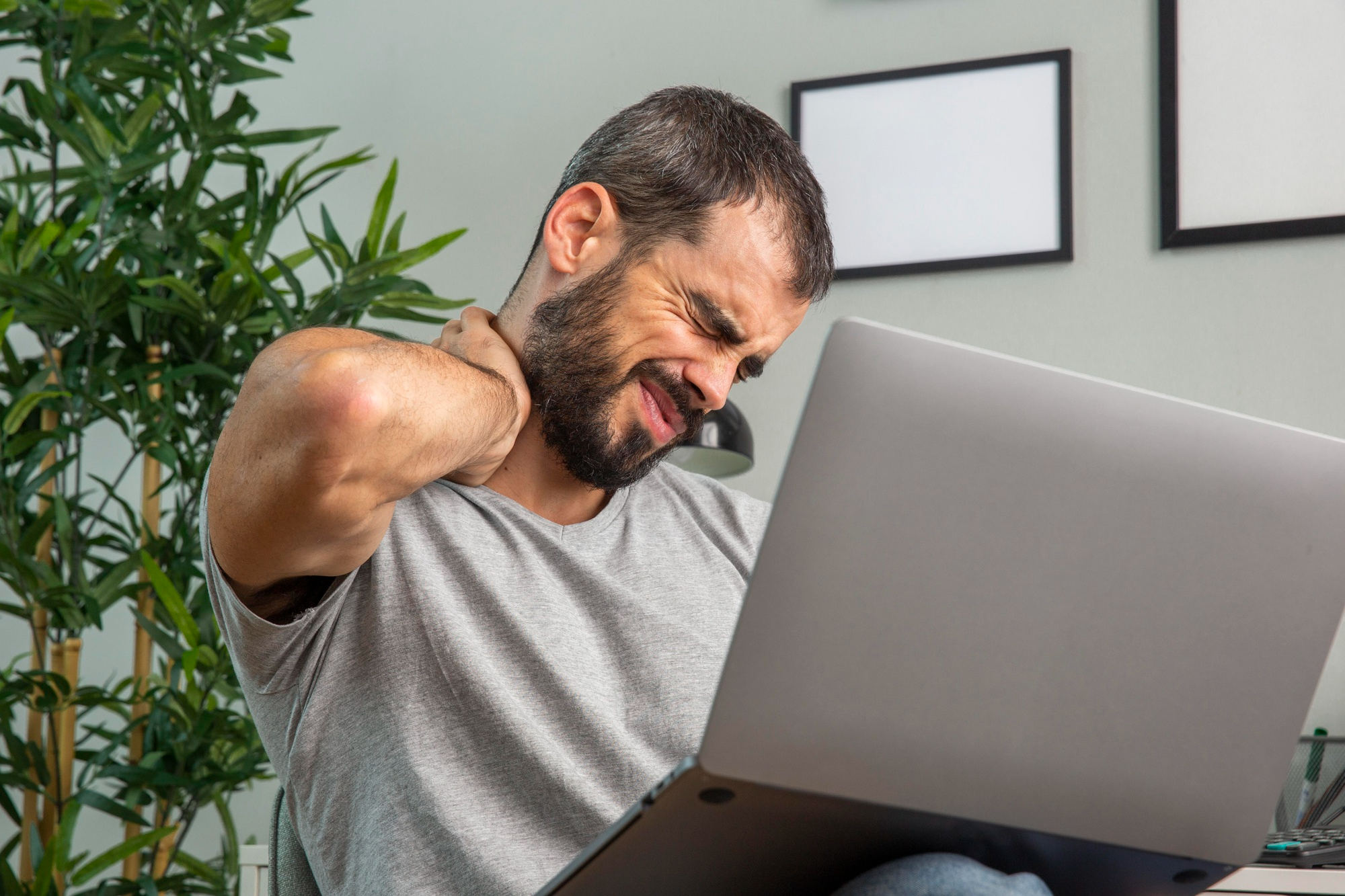
A young man experiencing neck pain from prolonged laptop use due to poor posture.
Neck pain is the fourth leading cause of disability worldwide, and India carries a growing share of this burden — driven largely by the epidemic of desk work and smartphone use that keep the neck in sustained forward flexion for hours every day. A generation ago, neck pain was predominantly a condition of middle-age and beyond. Today, it is strikingly common in people in their 20s and 30s.
"Cervical spondylosis" — a term used frequently in India — encompasses the age-related degenerative changes that occur in the cervical (neck) spine. It's normal to some degree after 40, visible on X-rays in 90% of people above 60, and symptomatic in a significant proportion of adults. Understanding what's causing the pain — and distinguishing structural disease from the far more common muscle-and-posture-related neck pain — is what guides effective management.
The cervical spine (C1 to C7) supports the head — roughly 5–7 kg of weight — while allowing the widest range of motion of any part of the spine. Seven vertebrae, intervertebral discs between them, facet joints at the back, and an elaborate network of muscles and ligaments accomplish this. The cervical spine also contains the spinal cord passing through the vertebral canal, and the nerve roots exiting at each level to supply the arms, hands, and diaphragm.
This combination of high mobility, significant load, and critical neurological structures makes the cervical spine vulnerable to pain from multiple sources.
The most common cause of neck pain, particularly in younger adults. Long hours at a desk, laptop, or smartphone — with the head held in a forward-flexed or rotated position — creates sustained muscle tension and fatigue in the posterior neck muscles, upper trapezius, and levator scapulae.
"Tech neck" (neck pain from prolonged smartphone or tablet use with the head hanging down) is a genuine epidemic. For every inch the head moves forward of its neutral position over the shoulders, the effective weight the neck muscles must support approximately doubles — a head 5 cm forward of neutral creates the equivalent of 12–15 kg of load on the neck.
This type of neck pain is:
Degenerative changes in the cervical discs and facet joints begin in most people from the 30s onwards and progress with age. Changes include:
Most people with these changes have no or mild symptoms. When symptoms occur, they include:
When a cervical disc herniates and presses on a nerve root, it causes cervical radiculopathy — pain, numbness, tingling, or weakness radiating from the neck into the arm and hand, in the specific distribution of the affected nerve.
Common patterns:
Neck pain alone, without arm symptoms, is rarely from disc herniation producing nerve compression.
If cervical degeneration or a large disc herniation compresses the spinal cord itself (not just the nerve roots), the condition is called cervical myelopathy. This is more serious and produces:
Cervical myelopathy is a surgical condition — the spinal cord compression needs to be relieved surgically to prevent progressive neurological deterioration. This is one presentation of neck pain that must not be treated conservatively alone.
Sudden neck pain and muscle spasm causing the head to be held tilted to one side — torticollis. Often occurs after sleeping in an awkward position, a sudden movement, or a chill (keeping neck exposed to cold wind or AC — a very common history in Indian patients). Usually resolves within days. Managed with heat, gentle movement, and NSAIDs.
Sudden acceleration-deceleration injury to the neck — most commonly from rear-end motor vehicle collision. Sprains the cervical ligaments and muscles. Produces neck pain, stiffness, headache, and sometimes dizziness or concentration difficulties. Most resolve within weeks; some become chronic.
Red flags requiring urgent evaluation:
Clinical examination: the pattern of arm symptoms, reflexes, and specific weakness guides diagnosis to the specific level of nerve root or cord involvement.
X-ray: shows bony changes — disc space narrowing, osteophytes, alignment. Doesn't show soft tissue structures.
MRI: the most informative investigation. Shows disc herniation, nerve root compression, spinal cord signal changes, and soft tissue. Essential for planning treatment of radiculopathy or myelopathy.
Posture correction: the single most important long-term intervention. The head should be positioned over the shoulders — ear aligned with the shoulder when viewed from the side. For desk workers, the screen should be at eye level (raise the laptop on a stand; use a separate keyboard), and a chair with good lumbar and cervical support matters.
Take breaks from sustained postures: stand and move for 2–3 minutes every 45–60 minutes. A timer reminder helps.
Gentle range-of-motion exercises daily:
Heat: warm pack on the neck and upper shoulders for 15–20 minutes. Reduces muscle spasm.
Massage: upper trapezius and posterior neck massage. Effective for muscle-related neck pain.
NSAIDs and muscle relaxants: for acute flares.
Most cervical radiculopathy from disc herniation resolves within 6–12 weeks with conservative management:
Cervical traction: gentle axial traction opens the intervertebral foramina, reducing nerve root compression. Applied by a physiotherapist. Effective for some cases of radiculopathy.
Physiotherapy: cervical mobilisation, traction, strengthening of deep cervical flexors.
Cervical collar: only for short-term use during acute severe pain. Prolonged use weakens neck muscles and prolongs recovery.
Epidural steroid injection: for severe, refractory radiculopathy — provides pain relief while the disc herniation resolves.
Surgery: for progressive neurological deficits, severe pain not responding to 6–12 weeks of conservative management, or myelopathy. Anterior cervical discectomy and fusion (ACDF) is the most common procedure.
At Prakash Hospital Noida, our physicians and orthopaedic team assess neck pain and cervical spondylosis — with clinical evaluation, X-ray and MRI where indicated, physiotherapy referral, pain management, and specialist assessment for complex cases including myelopathy.
Whether you live in Sector 18, Sector 62, Greater Noida West, or anywhere in the NCR, Prakash Hospital Noida is a trusted name for neck pain, cervical spondylosis, and orthopaedic care in Noida.

An ECG recorded while you walk on a treadmill, to check for reduced blood flow to the heart during exercise.
Removes large or prolapsing piles that haven't settled with diet, medicines or banding.
Replaces a damaged shoulder ball and socket to relieve arthritis pain and help you use your arm again.
Free tools to check your weight, plan a pregnancy, track calories and more.
We offer expert care across key specialties, including Medicine, Cardiology, Orthopaedics, ENT, Gynaecology, and more—delivering trusted treatment under one roof.
जानिए ओवेरियन सिस्ट के कारण, लक्षण और उपचार के तरीके। समय पर जांच, सही इलाज और देखभाल से इस समस्या को कैसे नियंत्रित किया जा सकता है, समझें।
12 May 2026
by Prakash Hospital

Learn about urinary tract infection (UTI), including symptoms, causes, diagnosis, treatment options, and prevention tips at Prakash Hospital.
17 Feb 2026
by Prakash Hospital

पेट की खराब सेहत से जुड़ी समस्याएं जैसे गैस, एसिडिटी, कब्ज़ और IBS क्यों होती हैं? जानिए इनके कारण, लक्षण और सही इलाज के उपाय Prakash Hospital।
13 Jan 2026
by Prakash Hospital

Oily skin causes in India, what makes it worse, and how to manage it with diet and skincare. Prakash Hospital Noida.
11 Sept 2026
by Prakash Hospital

Dry skin causes, best Indian remedies, and when it's something more serious. Prakash Hospital Noida.
10 Sept 2026
by Prakash Hospital

Skin pigmentation — what causes dark patches, melasma, and uneven skin tone, and what treatment works. Prakash Hospital Noida.
9 Sept 2026
by Prakash Hospital


Book a consultation with Prakash Hospital's specialists — 24/7 emergency care, 100+ doctors, NABH accredited.
View All Departments