


Vitamin B12 Deficiency: Symptoms, Risk Factors and What to Do
Vitamin B12 deficiency symptoms — tingling, fatigue, memory issues and more. Who's at risk in India and how to fix it. Prakash Hospital Noida.
30 Sept 2026
by Prakash Hospital
by Prakash Hospital
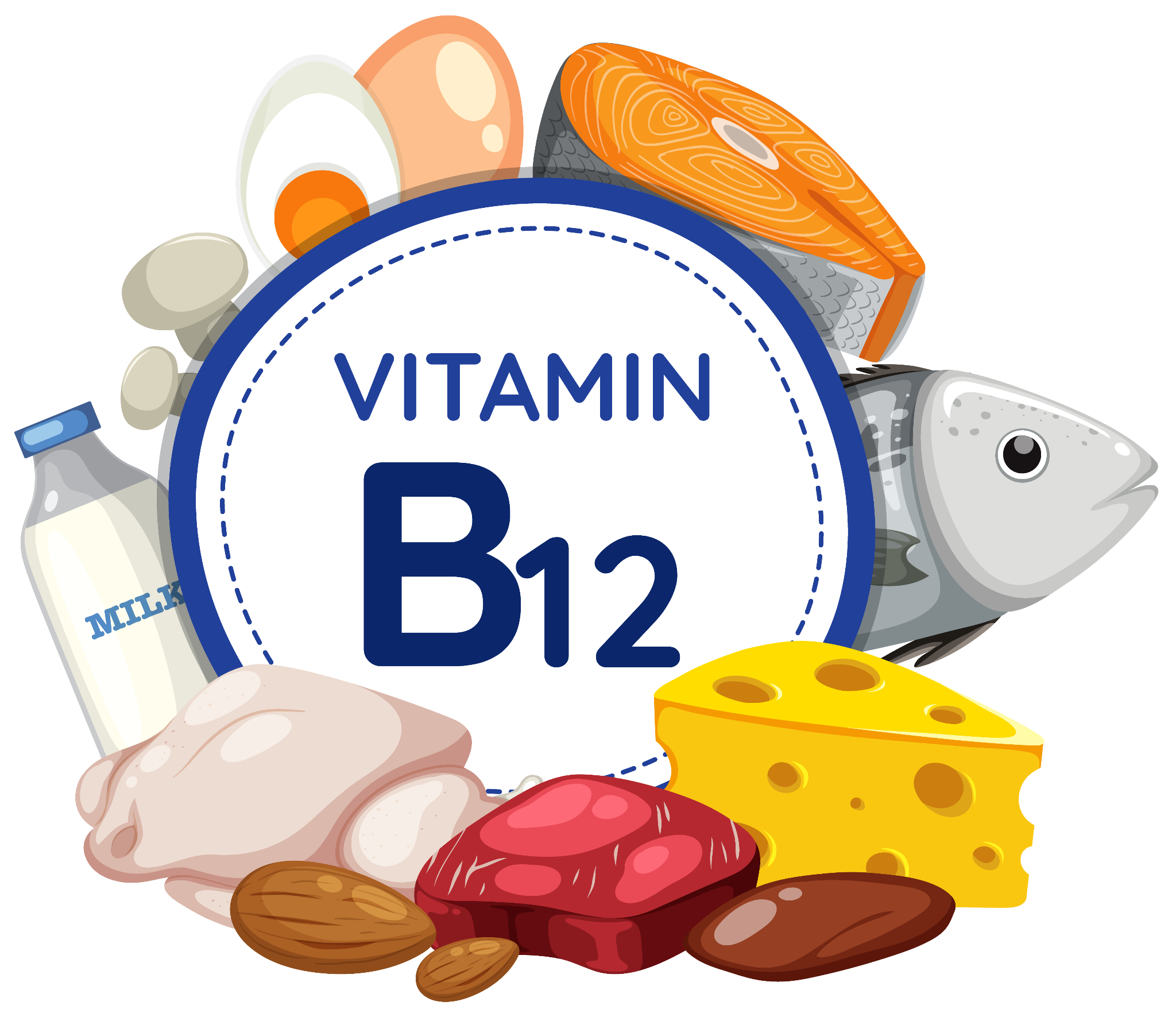
Vitamin B12 icon surrounded by healthy foods such as fish, eggs, and dairy to maintain nerve function, boosts energy levels and support mood balance, preventing deficiency-related health issues.
You feel tired all the time. Numbness in your hands and feet that comes and goes. Difficulty concentrating. A strange burning sensation on your tongue. Mood that has dipped without obvious reason. Pale skin that does not look quite right in the mirror.
These symptoms have many possible causes, but one of the most common and most missed is vitamin B12 deficiency. It is particularly widespread in India because much of the population is vegetarian, and B12 is found almost exclusively in animal-source foods.
The trouble is that vitamin B12 deficiency develops slowly. The body stores B12 in the liver, and it can take years for the stores to deplete before symptoms appear. Many people walk around mildly deficient for a long time without realising it.
This article explains what vitamin B12 deficiency is, how to recognise the symptoms, why it happens, the foods that help, and how it is properly treated.
Vitamin B12 — also called cobalamin — is essential for several critical functions in the body.
It helps make red blood cells, which carry oxygen to every tissue. Without enough B12, red blood cell production is disrupted and a specific kind of anaemia develops.
It supports the nervous system, particularly the protective myelin sheath around nerves. Long-term deficiency damages nerves in ways that may not fully reverse if not treated in time.
It is needed for DNA synthesis, which means every dividing cell in the body depends on it.
It plays a role in mood regulation, brain function, and energy production.
The body cannot make vitamin B12. It must come from food or supplements.
The recommended daily intake for most adults is 2.4 micrograms. Pregnant women need slightly more, around 2.6 micrograms. Breastfeeding women need 2.8 micrograms.
This is a small amount. The body stores 1000 to 2000 times this much in the liver, which is why deficiency develops slowly — usually over several years.
The deficiency is common globally and particularly common in India.
Studies of Indian populations consistently show high rates of B12 deficiency, ranging from 30 to 80 percent depending on the region and population studied. Urban vegetarians show the highest rates. Even non-vegetarians often have suboptimal levels.
This is one of the most underdiagnosed nutritional deficiencies in Indian healthcare.
The symptoms develop slowly and are often non-specific, which is why the deficiency goes unrecognised so often. Recognising the cluster of symptoms together is important.
One of the most common and earliest symptoms. Persistent tiredness despite adequate sleep. A general low-energy state. Easy fatigue with normal activities.
A subtle paleness, sometimes with a slight yellowish tint. This reflects the disrupted red blood cell production.
Even mild physical activity may leave you short of breath. The anaemia that develops with B12 deficiency reduces oxygen delivery to tissues.
Racing heart, fluttering sensations, or awareness of the heartbeat — all related to the cardiovascular effects of anaemia.
A distinctive symptom that should always prompt a B12 check. Numbness, tingling, or pins-and-needles sensations in the hands, feet, arms, or legs. This is the nerve damage starting.
In advanced deficiency, balance problems and difficulty walking can develop because of nerve damage affecting movement and coordination.
Difficulty concentrating. Forgetfulness. Mental cloudiness. In older adults, advanced B12 deficiency can mimic dementia.
Depression, anxiety, irritability, or general mood disturbance. The mood-vitamin B12 link is well established.
Inflamed, swollen, or red tongue. Sometimes a smooth, beefy-red tongue with loss of normal texture. Mouth ulcers and a burning sensation in the mouth.
Unexplained drop in appetite. Some weight loss without trying.
In severe cases, optic nerve damage can affect vision.
Both male and female fertility can be affected by long-term deficiency.
In infants of B12-deficient mothers, severe deficiency causes serious developmental problems and is a medical emergency.
Several causes contribute, often together.
Vitamin B12 occurs naturally only in animal products — fish, meat, poultry, eggs, dairy. Plants do not produce it.
This makes strict vegetarians and vegans particularly vulnerable. A vegan diet without fortified foods or supplements almost always leads to B12 deficiency over time.
Lacto-vegetarians and lacto-ovo-vegetarians get some B12 from dairy and eggs, but the amounts are often inadequate, especially with the relatively low B12 content of Indian dairy compared to Western dairy products.
Even people who eat enough B12 may not absorb it properly.
Pernicious anaemia is an autoimmune condition where the stomach cannot produce intrinsic factor, the protein needed to absorb B12. It is the classical cause of severe deficiency.
Atrophic gastritis reduces stomach acid production, which is needed to release B12 from food. It is common in older adults.
Stomach surgery including gastric bypass and partial gastrectomy reduces B12 absorption.
Intestinal conditions — Crohn's disease, celiac disease, severe IBS, intestinal parasites — can interfere with absorption.
Several medications affect B12 absorption or function:
Metformin, widely used for diabetes and PCOD, is one of the most common culprits. Long-term metformin use significantly increases B12 deficiency risk.
Proton pump inhibitors (PPIs) like omeprazole, taken long-term for acidity, reduce stomach acid and impair B12 absorption.
H2 blockers like ranitidine have similar effects.
Certain anti-seizure medications also affect B12.
Stomach acid production declines with age, reducing B12 absorption. Older adults need particular attention to B12 status.
Heavy alcohol use damages the stomach lining and interferes with B12 absorption and storage.
The biggest single risk factor for B12 deficiency in India is widespread vegetarianism.
Naturally, vitamin B12 occurs almost exclusively in animal products. A strict vegetarian diet without fortified foods or supplements simply does not provide enough.
This is not a moral or cultural judgment. It is biology. Plant foods do not contain meaningful amounts of vitamin B12. Some plant foods like spirulina and some fermented products contain B12 analogues that the human body cannot use effectively.
The practical implication: every strict vegetarian in India should either consume fortified foods reliably, take a B12 supplement, or both. Otherwise, deficiency is essentially inevitable over time.
For non-vegetarians, B12 sources are abundant.
Liver is the richest source. A small serving covers many days' worth of requirements.
Clams and other shellfish are extremely B12-rich.
Fish — salmon, tuna, sardines, mackerel — all provide good amounts.
Beef, lamb, mutton are good sources.
Chicken and other poultry provide moderate amounts.
Eggs provide modest but useful amounts. Two eggs provide a meaningful portion of daily needs.
Dairy products — milk, yogurt, paneer, cheese — provide reasonable amounts. A glass of milk gives roughly 1.2 micrograms, which is half the daily requirement.
For vegetarians:
Fortified plant milks — soy, almond, oat — are usually fortified with B12. A glass provides 1 microgram or more, depending on the brand.
Fortified breakfast cereals are widely available with added B12.
Fortified nutritional yeast is popular among vegans and provides substantial B12 per serving.
Fortified meat substitutes — some brands of tofu and faux meat — are fortified.
For strict vegetarians and vegans, B12 supplements are usually necessary to maintain adequate levels. The dose depends on age and individual factors, typically 25 to 100 micrograms daily for maintenance.
A blood test for serum vitamin B12 is the standard. Levels below 200 picograms per millilitre indicate deficiency. Levels between 200 and 300 pg/mL are considered borderline.
The test has some limitations, so doctors sometimes order additional tests when symptoms suggest deficiency despite borderline blood levels.
Methylmalonic acid (MMA) is a more sensitive marker. Elevated MMA indicates functional B12 deficiency even when serum B12 levels look acceptable.
Homocysteine is another marker that rises in B12 deficiency.
Complete blood count often shows macrocytic anaemia — large red blood cells — which is characteristic of B12 deficiency.
Intrinsic factor antibodies help diagnose pernicious anaemia.
Treatment depends on the cause and severity.
For mild deficiency caused by inadequate intake, adding B12-rich foods or fortified products may be enough.
Standard oral B12 supplements, typically as cyanocobalamin or methylcobalamin, are effective for most causes of deficiency. Doses range from 250 micrograms to 2000 micrograms daily depending on severity.
For older adults and those with absorption problems, oral supplements still work but require higher doses because only a small fraction is absorbed.
Tablets that dissolve under the tongue. Some evidence suggests they are absorbed slightly differently than swallowed tablets, though the actual benefit is debated. They are an option for people who do not tolerate regular tablets.
For severe deficiency, nerve symptoms, or pernicious anaemia, intramuscular injections of B12 are the treatment of choice. A typical protocol involves several injections over the first few weeks to replenish stores, followed by monthly maintenance injections.
Injections work reliably regardless of absorption issues, which is why they are preferred for severe cases.

A medical professional taking a blood sample in a laboratory, representing the diagnostic process for detecting Vitamin B12 deficiency.
Addressing the cause is part of treatment. Stopping or adjusting medications that affect B12 absorption. Treating intestinal conditions. Managing diabetes or other conditions appropriately.
People with permanent causes of malabsorption (pernicious anaemia, post-gastrectomy) usually need lifelong B12 supplementation or injections.
People taking long-term metformin or PPIs should have B12 levels checked periodically.
Strict vegetarians should make B12 supplementation a permanent habit.
Symptoms improve over weeks to months after treatment starts. Fatigue and general energy often improve first. Anaemia corrects within a few weeks of consistent treatment.
Nerve symptoms take longer to improve. Some nerve damage from prolonged deficiency may not fully reverse if treatment is delayed too long. This is why early diagnosis matters.
Some plant foods get listed as B12 sources online but do not actually provide usable B12.
Spirulina contains B12 analogues that the body cannot use and may actually interfere with real B12 metabolism.
Fermented foods like kimchi, miso, and tempeh contain very small amounts that are not reliable B12 sources.
Mushrooms do not naturally contain B12.
Algae products vary widely and are unreliable.
Strict vegetarians should rely on fortified foods and supplements, not these alternatives.
B12 deficiency during pregnancy affects the developing baby's brain and nervous system. Vegetarian pregnant women in particular need careful attention to B12 status, often with supplementation throughout pregnancy.
The baby gets B12 from breast milk. If the mother is deficient, the baby will be too. This is one of the most serious B12-related situations because infant B12 deficiency causes developmental problems.
Reduced stomach acid with age makes B12 absorption less efficient. Many older adults benefit from routine B12 supplementation, especially after age 50.
Metformin is excellent for managing diabetes and PCOD, but long-term use depletes B12. Periodic checks are appropriate, and supplementation may be needed.
Anyone with Crohn's disease, celiac disease, IBS, or post-bariatric surgery needs careful B12 monitoring and usually supplementation.
"Vegetarians can get B12 from plants." They cannot get reliable, usable B12 from unfortified plant foods. Fortified products and supplements are essential.
"Spirulina cures B12 deficiency." It does not. The B12 in spirulina is mostly analogues the body cannot use.
"B12 deficiency is rare in India." It is one of the most common deficiencies, particularly in vegetarian populations.
"Once you fix it, you do not need to worry again." Many causes are permanent. Long-term supplementation is often needed.
"More B12 is dangerous." B12 is water-soluble, and excess is excreted in urine. Toxicity from B12 is essentially unknown.
"You only need to worry about B12 if you are anaemic." Nerve damage can develop before anaemia. Early symptoms matter.
A consultation makes sense if you have persistent fatigue, numbness or tingling, mood changes, memory issues, mouth or tongue problems, or other symptoms suggestive of B12 deficiency. Strict vegetarians and people on long-term metformin or PPIs should have B12 checked routinely.
A simple blood test gives a clear answer, and treatment is usually straightforward.
Working professionals in Noida fall into multiple risk groups for B12 deficiency. Vegetarianism is common. Long-term metformin use for diabetes and PCOD is widespread. Long-term PPI use for acidity is increasing. Sedentary indoor lifestyles compound the picture.
The result is that B12 deficiency is one of the most common nutritional issues seen in clinics across NCR. Annual testing for at-risk groups is reasonable and often eye-opening.
At Prakash Hospital, Noida, experienced doctors offer B12 testing, comprehensive nutritional evaluation, and personalised treatment plans including dietary changes, oral supplementation, sublingual options, and injections when needed. Long-term follow-up ensures levels stay in the optimal range.
Whether you are in Sector 18, Sector 62, Greater Noida West, or anywhere nearby, Prakash Hospital Noida is a trusted name for nutrition consultation and health checkups.
To book a consultation, call the number.
Vitamin B12 deficiency is one of the most common and most overlooked nutritional problems in India. The symptoms — fatigue, weakness, numbness, mood changes, mouth and tongue problems, memory issues — often get attributed to other causes for years before the real culprit is identified.
The path forward is straightforward. Recognise the symptoms. Get a simple blood test. Address the cause and the deficiency together. Build long-term habits — fortified foods, supplements, periodic checks — that prevent the deficiency from returning.
For strict vegetarians, B12 supplementation should be a routine part of life rather than an occasional intervention. For people on metformin or PPIs, periodic B12 monitoring is sensible. For everyone, this is a deficiency worth taking seriously because the consequences of long-term untreated deficiency — particularly nerve damage — can be lasting.

A machine filters waste and extra fluid from the blood when the kidneys fail, usually in 4-hour sessions three times a week.
Realigns and rebuilds a joint damaged by injury, deformity or earlier surgery, keeping your own joint.
Replaces a worn or collapsed hip ball and socket with an artificial joint to end groin pain and restore walking.
Free tools to check your weight, plan a pregnancy, track calories and more.
We offer expert care across key specialties, including Medicine, Cardiology, Orthopaedics, ENT, Gynaecology, and more—delivering trusted treatment under one roof.
Vitamin B12 deficiency symptoms — tingling, fatigue, memory issues and more. Who's at risk in India and how to fix it. Prakash Hospital Noida.
30 Sept 2026
by Prakash Hospital

Vitamin D rich vegetables and fruits — what actually contains vitamin D and what is myth. Visit Prakash Hospital Noida for nutrition guidance.
30 Jun 2026
by Prakash Hospital
Vitamin C deficiency — recognise the signs, understand the causes, and learn the best food sources. Visit Prakash Hospital Noida for nutrition care.
26 Jun 2026
by Prakash Hospital

Detailed guide on gut health, gut microbiome imbalance, symptoms of poor gut health and scientifically proven ways to improve digestive health.
19 Feb 2026
by Prakash Hospital

IBS symptoms, causes, triggers, and management. What is irritable bowel syndrome and how to live with it. Prakash Hospital Noida.
15 Sept 2026
by Prakash Hospital

एसिडिटी और गैस क्यों होती है, इसके लक्षण क्या हैं और इससे राहत पाने के घरेलू व मेडिकल उपाय हिंदी में जानें।
21 Jan 2026
by Prakash Hospital

Monsoon brings dengue, malaria, viral fever, and gut infections. Here's how to strengthen your immunity before and during the season. Prakash Hospital Noida.
18 Aug 2026
by Prakash Hospital

Learn the signs of vitamin deficiencies in children, including Vitamin D, iron and more. Understand causes, symptoms, and how to prevent nutritional deficiencies in kids.
8 Apr 2026
by Prakash Hospital

Vitamin D3 foods — understand the difference between D2 and D3, top sources, and how to meet your needs. Visit Prakash Hospital Noida for nutrition consultation.
24 Jun 2026
by Prakash Hospital


Book a consultation with Prakash Hospital's specialists — 24/7 emergency care, 100+ doctors, NABH accredited.
View All Departments