


Dengue, Malaria, or Chikungunya? How to Tell the Difference
Dengue, malaria and chikungunya share many symptoms — here's how to tell them apart and when to get tested. Prakash Hospital Noida.
18 Aug 2026
by Prakash Hospital
by Prakash Hospital

A person experiencing high fever, representing one of the primary symptoms of dengue and emphasizing the need for early diagnosis and medical care.
Malaria remains one of the most significant vector-borne diseases in India, particularly during and after the monsoon months from June through October. In the NCR region — including Noida, Greater Noida, and surrounding areas — the Anopheles mosquito finds ideal breeding conditions in the accumulated rainwater of urban and peri-urban environments. Every year, cases spike between July and September, and every year, a significant number of people present to hospitals later than they should because they waited to see whether "the fever would pass on its own."
It sometimes does. But the types of malaria that don't are genuinely dangerous — capable of progressing to severe complications within 24 to 48 hours. Recognising the symptoms early and getting tested promptly is what separates manageable malaria from a hospital emergency.
Malaria is caused by Plasmodium parasites — single-celled organisms that enter the bloodstream through the bite of an infected female Anopheles mosquito. Unlike the Aedes mosquito that transmits dengue and chikungunya (which bites mainly during the day), the Anopheles mosquito bites primarily at night — from dusk to dawn.
Four main Plasmodium species cause malaria in India:
1. Plasmodium vivax: the most common in India, accounting for roughly 50–60% of cases. Generally less severe than falciparum, but can cause relapses months or even years later because dormant forms (hypnozoites) remain in the liver.
2. Plasmodium falciparum: the most dangerous. Causes the highest number of severe malaria cases and deaths. More common in tribal and forest areas but increasingly found in urban settings. Can progress to cerebral malaria, acute kidney injury, severe anaemia, and respiratory distress within 24–48 hours.
3. Plasmodium malariae and Plasmodium ovale: less common but present in parts of India.
The hallmark of malaria is a cyclical fever — it rises dramatically, peaks, then falls, in a pattern that repeats at intervals depending on the species. This is different from the sustained or spiking-and-holding fever pattern of bacterial infections.
1. Vivax malaria: classic 48-hour cycle — fever every other day (tertian malaria)
2. Falciparum malaria: 48-hour cycle but often irregular, making the pattern less obvious
3. Malariae: 72-hour cycle — fever every third day (quartan malaria)
The classical malaria paroxysm — the acute episode — has three stages:
Sudden shivering and chills, often severe. The person feels intensely cold despite having a rising temperature. Teeth chattering, goosebumps, and uncontrollable shaking. Many people describe this as one of the most uncomfortable experiences of the illness.
The temperature rises sharply — often to 39–41°C. The shivering stops and is replaced by feeling intensely hot. Severe headache, which can be very pronounced. Nausea and vomiting are common. The skin feels burning to touch. The person may be restless and, in severe cases, confused.
Profuse sweating as the fever breaks. The temperature falls rapidly. The person feels exhausted but the acute discomfort resolves. Between episodes, many people feel relatively well — this intermission is one of the characteristics that distinguishes malaria from many other serious febrile illnesses.
Beyond the classic fever cycle, malaria produces a range of symptoms:
Headache: often severe, present throughout the illness, particularly during the hot stage. One of the most prominent non-fever symptoms.
Muscle and joint pain: body aches and limb pain, similar in quality to flu-like illness. Can be pronounced.
Fatigue and weakness: profound tiredness, particularly after the sweating stage and throughout the illness.
Nausea and vomiting: common during the hot stage.
Loss of appetite: eating becomes unappealing during acute episodes.
Sweating: disproportionate sweating during the resolution phase of each episode.
Anaemia: malaria parasites invade and destroy red blood cells. Over repeated cycles, this produces anaemia — pallor, weakness, and fatigue disproportionate to the fever episodes. Visible pallor of the palms, conjunctiva (inner eyelid), and nail beds is a sign of anaemia.
Enlarged spleen (splenomegaly): the spleen enlarges as it works to filter damaged red blood cells. The left upper abdomen may feel heavy or tender. This is more prominent in repeated or chronic infections.
Jaundice: yellow discolouration of the eyes and skin — from the breakdown of haemoglobin when red blood cells are destroyed. More common with falciparum malaria.
These symptoms indicate severe or complicated malaria and require emergency hospitalisation:
Altered consciousness or confusion — cerebral malaria. The parasite obstructs small blood vessels in the brain, causing drowsiness, confusion, disorientation, or unconsciousness. This is a medical emergency.
Seizures — associated with cerebral malaria or very high fever.
Severe anaemia — extreme pallor, breathlessness at rest, very rapid heart rate.
Respiratory distress — rapid breathing, difficulty breathing, or breathing that appears laboured suggests fluid in the lungs or severe anaemia.
Very high fever above 40°C that isn't coming down with standard treatment.
Dark or brown urine — in severe falciparum malaria, massive red blood cell destruction releases haemoglobin into the blood, which spills into urine (blackwater fever). A serious sign.
Very reduced or no urine output — acute kidney injury from malaria.
Repeated vomiting — inability to keep oral medication or fluids down.
Bleeding tendency — unusual bruising or bleeding from gums or nose — associated with thrombocytopenia (low platelets).
Any of these requires immediate emergency care — do not wait.
These three illnesses overlap significantly in their initial presentation during monsoon season, and distinguishing them clinically without blood tests can be genuinely difficult. The key differences:
| Feature | Malaria | Dengue | Typhoid | |---|---|---|---| | Fever pattern | Cyclical (every 48–72 hours) | Sudden high fever, may remit | Stepwise rising fever | | Joint pain | Moderate | Severe (breakbone) | Mild | | Rash | Rare | Common | Rose spots (rare) | | Chills and rigors | Prominent, dramatic | Mild | Mild | | Mosquito bite time | Night | Day | None (waterborne) | | Platelet drop | Mild to moderate | Often severe | Mild | | Diarrhoea | Uncommon | Uncommon | Common |
Blood tests distinguish them definitively — rapid diagnostic tests (RDTs) for malaria and dengue NS1 antigen testing are available at most pathology laboratories.
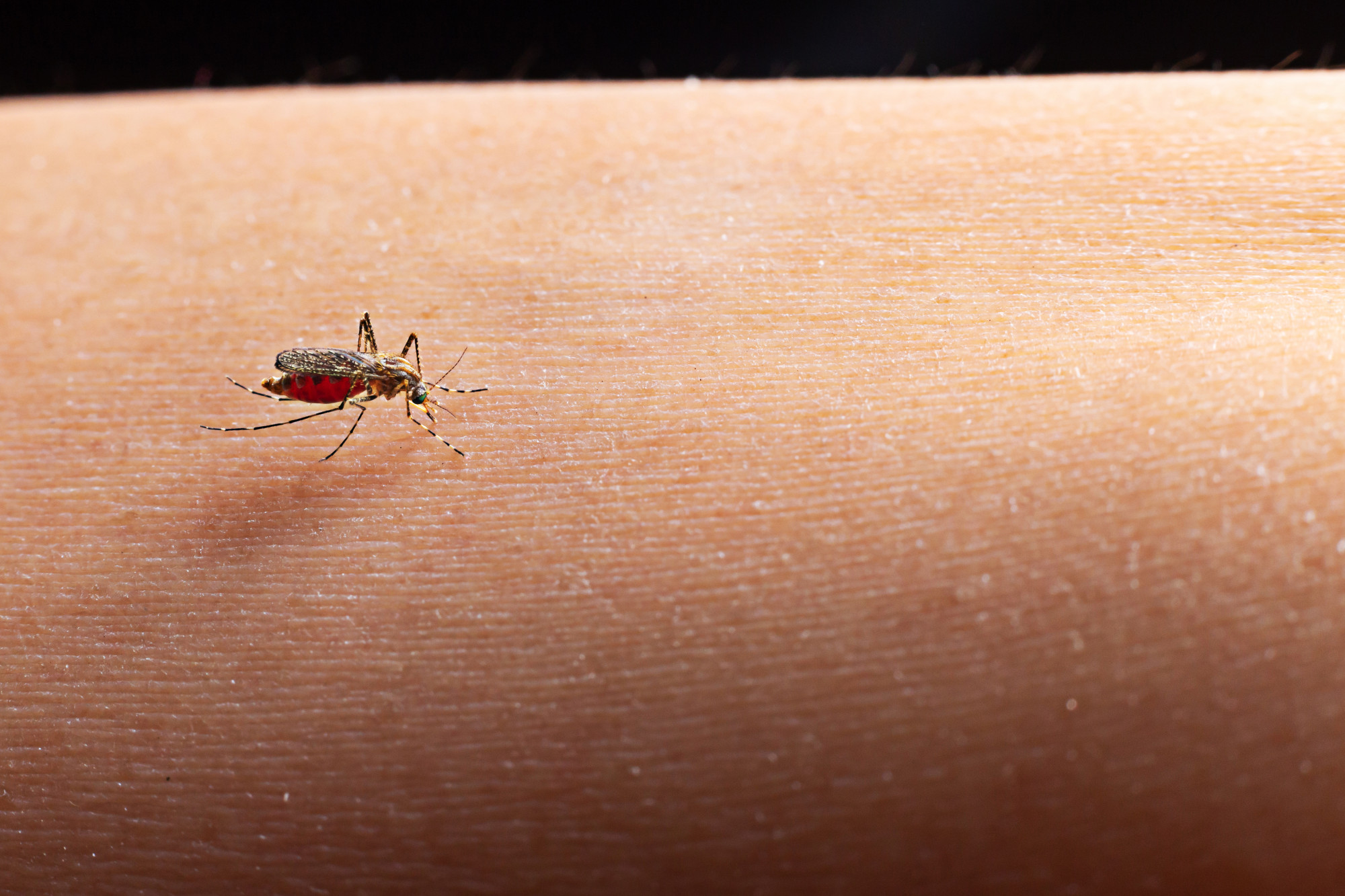
A mosquito biting human skin, illustrating disease transmission and highlighting symptoms, treatment, and prevention measures.
Rapid diagnostic test (RDT): a blood test using a fingerprick sample. Results available within 15–20 minutes. Detects malaria antigens. High sensitivity for falciparum and vivax. The most accessible test in India.
Peripheral blood smear (PBS): the microscopy gold standard. A blood drop is spread on a slide, stained, and examined under a microscope by a trained technician. Identifies the species, the parasite count, and the stage of infection. More sensitive than RDT for low-level infections. Considered the most accurate but requires laboratory infrastructure and skilled technicians.
WHO recommends testing before treating — don't start antimalarials based on symptoms alone, because the treatment differs by species and presumptive treatment of every fever as malaria is not appropriate.
Treatment depends entirely on the species:
Vivax malaria: chloroquine (usually, where not resistant) combined with primaquine (to eliminate the liver-stage parasites and prevent relapse). Primaquine requires G6PD testing first — primaquine causes haemolysis in G6PD-deficient individuals, which is common in India.
Falciparum malaria: artemisinin-based combination therapy (ACT) — artemether-lumefantrine or artesunate-amodiaquine. Chloroquine-resistant falciparum is very widespread; chloroquine should not be used for falciparum.
Severe malaria: intravenous artesunate or quinine in hospital. Supportive care for complications (fluid management, transfusion, dialysis if needed).
Completing the full course of medication is essential — stopping early because symptoms resolve leads to recrudescence (return of the infection) and contributes to drug resistance.
Mosquito nets: sleeping under insecticide-treated nets (ITNs), particularly between dusk and dawn when Anopheles mosquitoes bite.
Repellents: DEET-based repellents on exposed skin and clothing during evening and night hours.
Protective clothing: full-sleeved clothing, particularly in the evenings.
Eliminating breeding sites: Anopheles mosquitoes breed in clear, slow-moving or stagnant water — puddles, waterlogged areas, irrigation channels. Eliminating standing water around the home.
Indoor spraying: residual insecticide spraying in rooms.
No vaccine: unlike some other diseases, no widely available effective malaria vaccine exists for use in India at this time. Prevention relies on the above measures.
At Prakash Hospital Noida, our physicians provide malaria testing — rapid diagnostic tests and peripheral blood smear microscopy — alongside complete blood count, platelet count monitoring, and treatment based on confirmed species identification. For cases of severe malaria, inpatient management with IV artesunate and supportive care is available.
Whether you live in Sector 18, Sector 62, Greater Noida West, or anywhere in the NCR, Prakash Hospital Noida is a trusted name for malaria diagnosis, fever management, and general medicine in Noida.

This article covers general medicine concerns. These Prakash Hospital doctors in Noida treat them.

Dr. Birendra Pawar
Consultant Internal Medicine
Hysterectomies · Laparoscopic Hysterectomies · Gynecological Pathologies

Dr. Sunil P. Chaudhary
Consultant Internal Medicine
Diabetes · Hypertension · Thyroid Disorders
Records the brain's electrical activity through scalp electrodes to help diagnose epilepsy and seizures.
Permanent male contraception: the sperm tubes are cut and sealed under local anaesthetic in about 30 minutes.
A controlled acid solution lifts damaged surface skin to fade pigmentation, tanning and acne marks.
Free tools to check your weight, plan a pregnancy, track calories and more.
We offer expert care across key specialties, including Medicine, Cardiology, Orthopaedics, ENT, Gynaecology, and more—delivering trusted treatment under one roof.
Dengue, malaria and chikungunya share many symptoms — here's how to tell them apart and when to get tested. Prakash Hospital Noida.
18 Aug 2026
by Prakash Hospital

Learn about malaria symptoms, causes, diagnosis, treatment options, and effective prevention methods to protect yourself and your family.
13 Jan 2026
by Prakash Hospital
Monsoon brings dengue, malaria, viral fever, and gut infections. Here's how to strengthen your immunity before and during the season. Prakash Hospital Noida.
18 Aug 2026
by Prakash Hospital

COPD क्या है, इसके शुरुआती लक्षण क्या हैं और इसका इलाज कैसे होता है? जानिए क्रॉनिक ऑब्सट्रक्टिव पल्मोनरी डिजीज के बारे में पूरी जानकारी।
11 Mar 2026
by Prakash Hospital

Discover effective home remedies for dry and wet cough. Know when to seek medical care and get expert respiratory treatment at Prakash Hospital.
5 Feb 2026
by Prakash Hospital

ब्लड क्लॉट (खून का थक्का) क्या है, क्यों बनता है, इसके लक्षण क्या हैं और यह कितना खतरनाक हो सकता है, पूरी जानकारी आसान हिंदी में।
27 Apr 2026
by Prakash Hospital

Diabetes complications including eye, kidney, heart, nerve, and foot problems. Prevention and screening. Visit Prakash Hospital Noida.
21 Jul 2026
by Prakash Hospital

High cholesterol increases heart disease risk. Know causes, tests, and how to lower it. Visit Prakash Hospital Noida for cardiology care.
2 Jul 2026
by Prakash Hospital

Thyroid disorders affect millions in India. Know hypothyroidism, hyperthyroidism symptoms, tests, and treatment. Visit Prakash Hospital Noida.
8 Jul 2026
by Prakash Hospital


Book a consultation with Prakash Hospital's specialists — 24/7 emergency care, 100+ doctors, NABH accredited.
View All Departments