


किडनी रोग के शुरुआती लक्षण, कारण और बचाव
किडनी हमारे शरीर के लिए क्यों ज़रूरी है? जानिए किडनी रोग के शुरुआती लक्षण, कारण, जांच, डाइट और किडनी को स्वस्थ रखने के असरदार उपाय – Prakash Hospital।
14 Jan 2026
by Prakash Hospital
Dialysis you do at home, using the lining of your own abdomen as the filter, so your treatment fits around work and family instead of hospital slots.

Being told you need dialysis usually brings one picture to mind: a machine in a hospital, three mornings a week. For many people there is another option. Peritoneal dialysis is done at home, often while you sleep.
Your abdomen is lined by a thin membrane called the peritoneum, packed with tiny blood vessels. In peritoneal dialysis (PD), a sterile fluid called dialysate runs into your abdomen through a soft, permanent tube (catheter). Over a few hours, waste and extra water pass from your blood across the membrane into the fluid, which you then drain out and replace with fresh fluid. Each cycle is called an exchange. PD works more slowly than haemodialysis but every day, which is gentler on the heart and blood pressure.
PD doesn't cure kidney failure. It works well for years in many people, especially while their own kidneys still make some urine. Over time the membrane can filter less well, or infections may force a change, and many people eventually move to haemodialysis or have a transplant.
Our nephrology department offers both haemodialysis and peritoneal dialysis and helps you choose based on your health, home and work. Our dietitians plan meals around the food you already eat, and if you're heading for a transplant, we handle the pre-transplant workup.
PD treats the same kidney failure as haemodialysis. The choice often depends more on your life and other health problems than on the kidneys.
You do 3 to 5 exchanges a day by hand, usually with about 2 litres of fluid each time. Each takes 30 to 40 minutes, and the fluid stays in (dwells) for 4 to 6 hours in between, with one long dwell overnight. No machine is needed.
A machine called a cycler runs several exchanges while you sleep, over 8 to 10 hours, leaving your days mostly free. It suits people who work or study, and children.
The catheter goes in through a small cut below the navel, under local or general anaesthesia, by keyhole surgery or a needle technique. The site ideally heals for about 2 weeks before full use. If dialysis is needed sooner, PD can sometimes start with small volumes, or haemodialysis bridges the gap.
Close the windows, switch off the fan and put on a mask. Wash and dry your hands thoroughly, and check the new bag for leaks, expiry date and strength. Warm it with a heating pad if needed, never in a microwave.
You connect the bag set to your catheter and let the used fluid drain out by gravity, which takes about 15 to 20 minutes. Check that it's clear.
A little fresh fluid flushes the tubing to clear air, then the new fluid runs into your abdomen over about 10 minutes.
You clamp the lines, disconnect and put a sterile cap on the catheter. The fluid does its work while you get on with your day.
Expect a few weeks of learning, and of getting used to the feeling of fluid in your abdomen, before exchanges feel routine.
Most people stay 1 to 2 days after the catheter goes in, and the site stays dry and dressed for about 2 weeks. A dialysis nurse then trains you and a family member, usually over 5 to 10 days, until you can do exchanges and care for the exit site on your own.
Eat more protein than before, from dal, paneer, eggs, fish or chicken, because some is lost into the fluid. Our list of protein-rich foods gives ideas. Salt and fluids are still limited, but potassium limits are often looser than on haemodialysis. Your dietitian sets your targets.
You can work, travel and exercise. Showers are fine once the exit site has healed, but avoid swimming pools, rivers and tub baths. Wear loose waistbands and tape the catheter down so it doesn't pull.
Monthly visits review your blood tests, blood pressure and weight, and your PD diary of weights and drained volumes. The prescription changes as your own kidney function falls.
Call us on +91-8826000033 or come straight to our 24/7 emergency department.
A machine cleans your blood, usually for about 4 hours three times a week in a dialysis unit, with nothing to do at home. It needs an AV fistula made well in advance, and suits people who would rather the team handled dialysis.
For those fit enough, a transplant usually gives the most normal life. PD keeps you well while donor tests and matching are done.
Talk to our Nephrology team
Ask about your options, the cost and your insurance before you decide. See the insurance and TPA panels we work with.
This page explains Peritoneal Dialysis (CAPD and APD) in general terms. Your own plan depends on your health, your test results and your doctor's advice. Please read our medical disclaimer.
Peritoneal Dialysis (CAPD and APD) is led by our Nephrology team, with other departments stepping in at each stage of your care.
At Prakash Hospital, our Nephrology Department delivers specialized care for kidney health, providing advanced diagnosis, treatment, and management for a wide range of kidney-related conditions to help you maintain optimal health and well-being.
What the department treats
Hemodialysis
Peritoneal Dialysis
Kidney Biopsy
CKD Management
Transplant Evaluation
Electrolyte Management
Procedures often considered alongside Peritoneal Dialysis (CAPD and APD), or that treat related conditions.
A machine filters waste and extra fluid from the blood when the kidneys fail, usually in 4-hour sessions three times a week.
A minor operation joining an artery to a vein in the arm to create lasting access for haemodialysis.
A needle sample of kidney tissue that finds the cause of protein or blood in the urine, or of failing kidneys.
Pushes the bulge back and reinforces the weak abdominal wall with mesh, by keyhole or open surgery.
We offer expert care across key specialties, including Medicine, Cardiology, Orthopaedics, ENT, Gynaecology, and more—delivering trusted treatment under one roof.
Free tools to check your weight, plan a pregnancy, track calories and more.
किडनी हमारे शरीर के लिए क्यों ज़रूरी है? जानिए किडनी रोग के शुरुआती लक्षण, कारण, जांच, डाइट और किडनी को स्वस्थ रखने के असरदार उपाय – Prakash Hospital।
14 Jan 2026
by Prakash Hospital

Learn why kidney disease early detection matters in 2025. Discover signs, causes, treatment options, and how screening can protect your health.
6 May 2025
by Prakash Hospital

जानिए किडनी फंक्शन टेस्ट (KFT) क्या होता है, यह किन-किन पैरामीटर्स को मापता है और किडनी की सेहत के बारे में क्या जानकारी देता है।
11 May 2026
by Prakash Hospital

Does dandruff cause hair fall? The link between scalp inflammation and hair loss — and how to treat both. Prakash Hospital Noida.
7 Sept 2026
by Prakash Hospital

Natural ways to stop hair fall at home — diet, scalp care, Ayurvedic remedies with evidence, and what to avoid. Prakash Hospital Noida.
2 Sept 2026
by Prakash Hospital

Hair fall in men — male pattern baldness, causes, and what treatments actually work. Guide from Prakash Hospital Noida, Noida.
7 Sept 2026
by Prakash Hospital
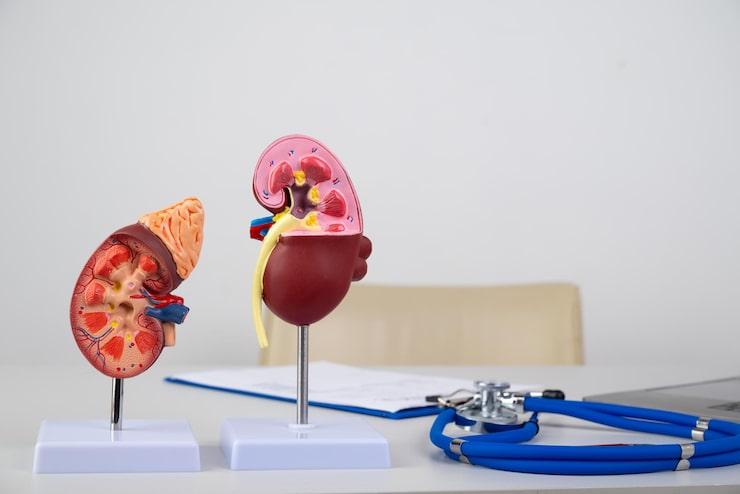
Learn the basics of kidney stone removal to be prepared with the guidance of the best in the field from Prakash Hospital.
14 Aug 2025
by Prakash Hospital

किडनी स्टोन क्यों होता है, इसके लक्षण क्या हैं और बिना सर्जरी किडनी स्टोन का आधुनिक इलाज हिंदी में जानें।
20 Jan 2026
by Prakash Hospital
Answers to common questions about Peritoneal Dialysis (CAPD and APD) at Prakash Hospital, Noida.


Book a consultation with Prakash Hospital's specialists — 24/7 emergency care, 100+ doctors, NABH accredited.
View All Departments