


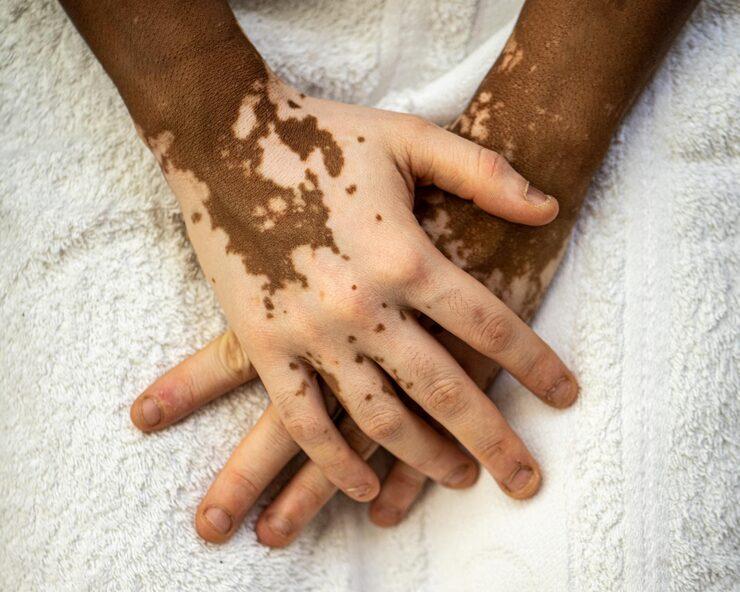
Managing Vitiligo: Latest Medical and Surgical Treatments
Learn all about Vitiligo and its innovative treatments with the insight of the doctors at Prakash Hospital, Noida.
17 Sept 2025
by Prakash Hospital
Treatment to stop white patches spreading and bring colour back, planned around how active your vitiligo is and where the patches are.

A white patch appears near an eye or on a finger, and within weeks the whole family has advice: stop eating fish with milk, avoid anything sour, try this oil. Vitiligo is common in India and still carries myths and stigma, which can weigh on people more than the patches themselves.
In vitiligo, the immune system attacks melanocytes, the cells that make skin pigment, so patches of skin lose their colour. It isn't infectious and has nothing to do with what you eat. Vitiligo treatment aims first to stop new patches forming and then to bring colour back. Creams calm the immune attack in the skin. Ultraviolet light therapy prompts pigment cells from hair roots and patch edges to spread back in. When the disease has been quiet for a long time, pigment cells can also be moved surgically from normal skin into the patches.
Results vary more than most people expect. The face and neck often respond well. Lips, fingertips, hands and feet respond slowly, because they have few hair roots to supply new pigment. Colour takes months to return, and patches can come back, so vitiligo is managed over years. Many people regain a good deal of colour, and even when they don't, stopping the spread matters a lot.
Our skin and hair department treats vitiligo and other pigment disorders. A Wood's lamp examination maps your patches, including faint ones you may not see in daylight, and helps tell vitiligo apart from other causes of white patches. We set realistic expectations at the start, because vitiligo usually needs ongoing care, and build a plan that fits your routine.
Not every white patch is vitiligo. A fungal infection, pityriasis alba in children, pale skin left after eczema and the numb patches of leprosy can all look similar, so the diagnosis is confirmed first.
Steroid creams and calcineurin inhibitor ointments (tacrolimus or pimecrolimus) calm the immune attack. Tacrolimus is often chosen for the face, eyelids and children, because it doesn't thin the skin. Creams suit small or early patches and are used for several months.
Narrowband ultraviolet B (NB-UVB) is the most widely used light treatment for vitiligo that covers larger areas. You stand in a light cabinet, or a handheld unit treats single patches, for seconds to minutes, 2 to 3 times a week. It takes 6 months or more to judge the response, so pick a place you can reach easily.
When patches are spreading fast, a steroid tablet taken on only two days a week (oral mini-pulse therapy) can help halt the spread, with fewer side effects than daily steroids. Newer medicines called JAK inhibitors, as creams or tablets, are used in selected cases, and your dermatologist can tell you whether one suits you.
If there have been no new or growing patches for at least a year, pigment cells can be moved from normal skin using small punch grafts, thin skin grafts, blister-roof grafts or a cell suspension. Segmental vitiligo tends to respond well. Some patients are referred to a centre that specialises in vitiligo surgery.
Your dermatologist examines the patches under a Wood's lamp, which makes skin without pigment glow bright white, and checks sensation to rule out other causes.
Blood tests look for thyroid disease and sometimes diabetes or vitamin B12 deficiency, which turn up more often alongside vitiligo.
New patches, spreading or blurred edges, tiny confetti-like spots or patches appearing at cuts all point to active disease, which is treated first to stop the spread. Stable disease is treated to restore colour.
Most people begin with creams, light therapy or both, sometimes with a short course of tablets. The mix depends on how much skin is affected and where, your age, and what you can keep up.
You're reviewed every 1 to 3 months with photographs. A treatment that hasn't worked after a fair trial is changed rather than continued indefinitely.
Vitiligo treatment is slow and measured in months.
You settle into the routine of creams and sessions. Often nothing visible changes at first. A lack of new patches is usually the first sign that treatment is working.
Colour often returns as small brown dots around hair roots that slowly join up, or creeps in from the edges of a patch. The face can respond within months. Hands and feet may take a year or more.
Wear sunscreen on exposed patches, and avoid friction, tight clothing and cuts where you can, since injured skin can lose its colour too.
Some colour can fade again after treatment stops, so your dermatologist may suggest a maintenance cream a few days a week. Camouflage creams are a safe way to cover patches whenever you want.
Call us on +91-8826000033 or come straight to our 24/7 emergency department.
Waterproof cover creams and self-tanning products hide patches without treating them. Many people use them for weddings and events while treatment continues.
When most of the body has lost colour and treatment hasn't worked, some people choose to lighten the remaining skin so their tone is even. It is permanent and only considered after long discussion.
Some people with small, stable patches leave them untreated. That is a valid choice if you protect the patches from the sun.
Talk to our Dermatology & Cosmetic Surgery team
Ask about your options, the cost and your insurance before you decide. See the insurance and TPA panels we work with.
This page explains Vitiligo Treatment in general terms. Your own plan depends on your health, your test results and your doctor's advice. Please read our medical disclaimer.
Vitiligo Treatment is led by our Dermatology & Cosmetic Surgery team, with other departments stepping in at each stage of your care.
At Prakash Hospital, our Skin and Hair Department offers personalized dermatology and cosmetic care, delivering advanced treatments for healthier skin and stronger hair.
What the department treats
Acne Management
Hair Restoration (PRP)
Laser Therapy
Chemical Peels
Anti-Aging Treatments
Vitiligo Treatment
Checks and treats thyroid disease, diabetes and vitamin B12 deficiency, which are more common with vitiligo.
Offers counselling if the patches, or other people's reactions to them, affect your mood or confidence.
Supports children with vitiligo and looks out for related conditions as they grow.
Procedures often considered alongside Vitiligo Treatment, or that treat related conditions.
Surgery, often with injections, to make wide, raised or tight scars flatter and less noticeable.
A controlled acid solution lifts damaged surface skin to fade pigmentation, tanning and acne marks.
Gentle exfoliation that removes dead surface skin to brighten dull skin and soften light marks, with no downtime.
Other procedures our Dermatology & Cosmetic Surgery team performs.
Laser light damages hair roots to reduce unwanted hair over 6 to 8 sessions, with settings matched to your skin.
Anti-wrinkle injections and hyaluronic acid fillers that soften lines and restore facial volume, with no downtime.
Microneedling, laser, peels and minor procedures matched to your scar type to smooth pitted acne scars.
We offer expert care across key specialties, including Medicine, Cardiology, Orthopaedics, ENT, Gynaecology, and more—delivering trusted treatment under one roof.
Free tools to check your weight, plan a pregnancy, track calories and more.
Learn all about Vitiligo and its innovative treatments with the insight of the doctors at Prakash Hospital, Noida.
17 Sept 2025
by Prakash Hospital

White patches on face — understand what causes them, when they are concerning, and treatment options. Visit Prakash Hospital Noida for dermatology consultation.
26 May 2026
by Prakash Hospital

Protect your skin barrier this winter with dermatologist-approved skincare tips and routines by Prakash Hospital.
19 Nov 2025
by Prakash Hospital

ब्लड क्लॉट (खून का थक्का) क्या है, क्यों बनता है, इसके लक्षण क्या हैं और यह कितना खतरनाक हो सकता है, पूरी जानकारी आसान हिंदी में।
27 Apr 2026
by Prakash Hospital

Discover effective home remedies for dry and wet cough. Know when to seek medical care and get expert respiratory treatment at Prakash Hospital.
5 Feb 2026
by Prakash Hospital

COPD क्या है, इसके शुरुआती लक्षण क्या हैं और इसका इलाज कैसे होता है? जानिए क्रॉनिक ऑब्सट्रक्टिव पल्मोनरी डिजीज के बारे में पूरी जानकारी।
11 Mar 2026
by Prakash Hospital

Which vitamin deficiencies cause hair fall — iron, vitamin D, B12, and zinc. How to test and fix them. Prakash Hospital Noida.
4 Sept 2026
by Prakash Hospital

How to stop hair fall with diet, lifestyle changes, and proven treatments. Indian-specific guide from Prakash Hospital Noida.
1 Sept 2026
by Prakash Hospital

क्या आपके बाल धीरे बढ़ रहे हैं? जानिए इसके मुख्य कारण जैसे पोषण की कमी, तनाव, हार्मोनल बदलाव और गलत हेयर केयर। साथ ही, बालों की ग्रोथ तेज करने के असरदार घरेलू उपाय और आसान टिप्स भी पढ़ें।
5 May 2026
by Prakash Hospital
Answers to common questions about Vitiligo Treatment at Prakash Hospital, Noida.


Book a consultation with Prakash Hospital's specialists — 24/7 emergency care, 100+ doctors, NABH accredited.
View All Departments