


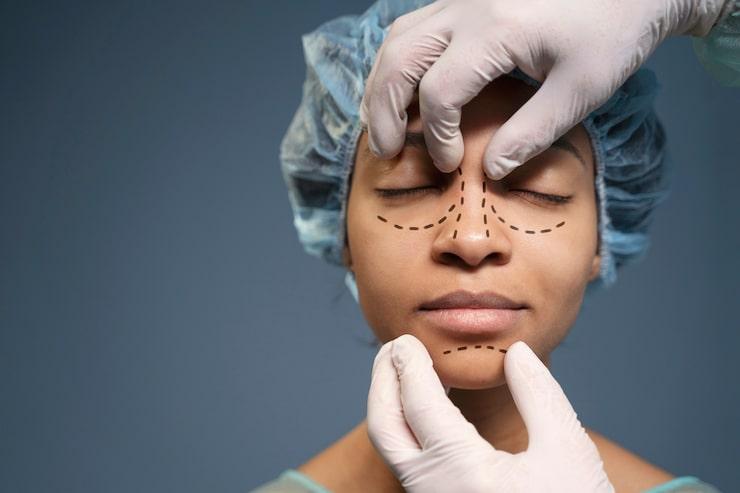
What You Need to Know Before Getting Nose Surgery: Cosmetic vs. Medical Reasons
Learn all you need to before getting nose surgery with special insight from doctors at Prakash Hospital, Noida.
19 Aug 2025
by Prakash Hospital
Opens blocked sinus drainage channels and removes polyps through the nostrils, for chronic sinusitis that medicines haven't cleared.

Your nose has been blocked since last winter. Thick mucus drips down the back of your throat, your face feels heavy when you bend forward, and food doesn't taste of much any more. You've finished course after course of antibiotics and sprays, and the relief lasts only as long as the medicine does.
The sinuses are air spaces in the bones around the nose and eyes. They drain into the nose through narrow channels. When those channels stay swollen, or are blocked by polyps (soft, grape-like swellings of the lining), mucus pools and the lining stays inflamed. In functional endoscopic sinus surgery (FESS), the surgeon passes a thin telescope called an endoscope through the nostrils and, watching on a video screen, removes the blockages and widens the natural drainage openings. Healthy lining is left in place so the sinuses can clear themselves again, which is where the word "functional" comes from.
Most people breathe more easily and have fewer infections afterwards, and many with polyps find their sense of smell improving. Surgery doesn't switch off the underlying tendency to inflammation, though. People with polyps, asthma or allergy usually need a steroid spray or rinse long term, and polyps can return in some.
Chronic sinusitis and nasal polyps are among the conditions our ENT department treats most often, with medicines first and FESS when medical treatment has had a fair trial. We assess you with video endoscopy of the nose and a CT scan of the sinuses before deciding.
FESS is for sinus disease that persists despite proper medical treatment, usually several weeks of saline rinses, steroid sprays and, where appropriate, antibiotics or steroid tablets. A CT scan confirms which sinuses are blocked and maps the anatomy before surgery.
The operation is tailored to your CT scan. Some people only need the main drainage pathway of the cheek and front ethmoid sinuses opened. Others, with widespread polyps, need every sinus opened on both sides.
A bent septum can block both the surgeon's view and your sinus drainage, so it's often straightened in the same sitting. Read about septoplasty.
A small balloon passed through the nose widens some sinus openings without removing tissue. It suits a small group of people with limited disease and no polyps.
You're under general anaesthesia. The lining of the nose is treated with a decongestant and local anaesthetic to shrink it and reduce bleeding.
The endoscope goes in through a nostril, giving a magnified view on screen. Nothing is cut on the face.
Polyps and swollen tissue blocking the drainage pathways are removed with fine instruments or a small powered shaver. Removed tissue is sent to the laboratory.
The natural openings of the affected sinuses are widened, and thin partitions of bone that block drainage are taken away. The surgeon works carefully here, because the eye and the base of the skull lie close by.
Thick mucus or fungal debris is washed out, and dissolvable packs or soft splints may be placed. The operation takes 1 to 3 hours, depending on how many sinuses are involved.
Recovering from sinus surgery is mostly about keeping the nose clean while it heals. The first two weeks feel like a heavy cold.
Blood-stained discharge is normal for a day or two, and you'll wear a small gauze pad under the nose. You'll usually go home that evening or the next morning.
Start saline rinses as instructed, often 2 to 4 times a day. Sleep with your head raised, and avoid blowing hard, bending, lifting and straining. Blockage and crusting are expected. Most people return to desk work in about a week.
Clinic visits clear crusts and check healing, usually at 1 to 2 weeks and again a few weeks later. Breathing and smell keep improving as the swelling settles. Stay away from dusty sites, swimming and heavy exercise until your surgeon says it's fine.
The lining has usually healed by 3 months. If you have polyps or allergy, carry on with your steroid spray or rinse to help stop them returning, and keep your review appointments.
Call us on +91-8826000033 or come straight to our 24/7 emergency department.
Saline rinses, steroid sprays used with the right technique, and short courses of steroid tablets or antibiotics control symptoms for many people. Even after surgery you'll keep using some of them, because an opened sinus lets them reach where they're needed.
If allergic rhinitis drives your symptoms, allergy testing, avoiding triggers and regular medicines may help more than an operation.
Sinusitis on one side sometimes comes from an infected upper back tooth. Treating the tooth can clear the sinus without sinus surgery.
Talk to our ENT team
Ask about your options, the cost and your insurance before you decide. See the insurance and TPA panels we work with.
This page explains FESS (Functional Endoscopic Sinus Surgery) in general terms. Your own plan depends on your health, your test results and your doctor's advice. Please read our medical disclaimer.
FESS (Functional Endoscopic Sinus Surgery) is led by our ENT team, with other departments stepping in at each stage of your care.
At Prakash Hospital, our ENT Department offers expert diagnosis and advanced treatments for ear, nose, throat, head, and neck conditions, ensuring better health and quality of life for all ages.
What the department treats
Sinus Surgery (FESS)
Tympanoplasty
Septoplasty
Tonsillectomy
Hearing Aid Fitting
Allergy Management
Procedures often considered alongside FESS (Functional Endoscopic Sinus Surgery), or that treat related conditions.
Straightens the bent wall inside the nose to relieve a constantly blocked nostril, with no cut outside.
Removes enlarged adenoids that block a child's nose, disturb sleep or keep causing ear infections.
Removes tonsils that cause repeated throat infections or block a child's breathing during sleep.
Examines the vocal cords under a microscope to remove growths or take a biopsy, working through the mouth.
Closes a hole in the eardrum with your own tissue to stop ear discharge and protect or improve hearing.
Other procedures our ENT team performs.
We offer expert care across key specialties, including Medicine, Cardiology, Orthopaedics, ENT, Gynaecology, and more—delivering trusted treatment under one roof.
Free tools to check your weight, plan a pregnancy, track calories and more.
Learn all you need to before getting nose surgery with special insight from doctors at Prakash Hospital, Noida.
19 Aug 2025
by Prakash Hospital

Sore throat treatment, home remedies that work, and warning signs that mean you need medical care. Visit Prakash Hospital Noida for consultation.
25 Jun 2026
by Prakash Hospital

एलर्जी (Allergy) क्या है? जानिए इसके कारण, लक्षण, प्रकार, इलाज और बचाव के आसान तरीके। एलर्जी से जुड़ी सही जानकारी और उपचार | Prakash Hospital
17 Dec 2025
by Prakash Hospital

ब्लड क्लॉट (खून का थक्का) क्या है, क्यों बनता है, इसके लक्षण क्या हैं और यह कितना खतरनाक हो सकता है, पूरी जानकारी आसान हिंदी में।
27 Apr 2026
by Prakash Hospital

Discover effective home remedies for dry and wet cough. Know when to seek medical care and get expert respiratory treatment at Prakash Hospital.
5 Feb 2026
by Prakash Hospital

COPD क्या है, इसके शुरुआती लक्षण क्या हैं और इसका इलाज कैसे होता है? जानिए क्रॉनिक ऑब्सट्रक्टिव पल्मोनरी डिजीज के बारे में पूरी जानकारी।
11 Mar 2026
by Prakash Hospital
Learn everything about Cochlear implants through this helpful guide with the advice of seasoned experts from Prakash Hospital, Noida.
25 Aug 2025
by Prakash Hospital

Learn what triggers ear infections, how to spot symptoms early, and which treatments work best for both children and adults.
4 May 2025
by Prakash Hospital

Discover the common causes of lumps behind the ear and how to identify when it's time to seek medical care. Learn about treatment options and diagnostic steps.
10 May 2025
by Prakash Hospital
Answers to common questions about FESS (Functional Endoscopic Sinus Surgery) at Prakash Hospital, Noida.


Book a consultation with Prakash Hospital's specialists — 24/7 emergency care, 100+ doctors, NABH accredited.
View All Departments