


किडनी रोग के शुरुआती लक्षण, कारण और बचाव
किडनी हमारे शरीर के लिए क्यों ज़रूरी है? जानिए किडनी रोग के शुरुआती लक्षण, कारण, जांच, डाइट और किडनी को स्वस्थ रखने के असरदार उपाय – Prakash Hospital।
14 Jan 2026
by Prakash Hospital
When your kidneys can no longer clean your blood, a dialysis machine does the job, usually three times a week, so you can get on with work and family life.

Healthy kidneys filter your blood many times a day, removing waste, extra salt and water. When they fail, all of that builds up. You feel exhausted and short of breath, your ankles and face swell, food stops appealing, and eventually the build-up becomes dangerous.
Haemodialysis takes over that filtering. Blood leaves your body through a needle or tube, passes through a filter called a dialyser, and comes back cleaned. Inside the dialyser, a fluid called dialysate draws waste and extra water out of your blood across a thin membrane, while the machine controls the flow and how much fluid is removed.
Dialysis doesn't cure kidney failure. For most people it continues long term, or until they get a kidney transplant. But once the routine settles, many people go back to work and a fairly normal week.
Our nephrology department runs the dialysis unit with individual patient stations, water treatment that meets international purity standards and trained nephrology nurses. A nephrologist reviews you at every session, and we keep a close eye on your dry weight, haemoglobin and blood chemistry in between.
Most people start dialysis because of end-stage kidney disease, usually after years of diabetes or high blood pressure. Others need it for a short time after sudden kidney failure, and their kidneys recover.
The preferred access. A surgeon joins an artery to a vein in your arm so the vein grows thick and strong enough for dialysis needles. It takes 6 to 8 weeks or more to mature, so it's best made well before you need dialysis. Read about AV fistula creation.
A soft plastic tube joins an artery and a vein when your own veins are too small. It can be used within 2 to 3 weeks, but it clots and gets infected more often than a fistula.
A tube placed in a large vein in the neck, used when dialysis has to start urgently. It works the same day, but infections are more common, so it's meant as a bridge until a fistula is ready.
You're weighed and your blood pressure and temperature are checked. Your weight compared with your dry weight (your weight without extra fluid) tells the team how much fluid to remove.
A nurse cleans your fistula arm and places two needles, one to take blood out and one to return it. With a catheter, the lines connect without needles. A blood thinner stops clotting in the tubing.
Your blood flows through the dialyser and straight back to you. Only a small amount is outside your body at any moment. You can read, watch something, chat or sleep.
The machine and nurses track your blood pressure and fluid removal throughout. If your pressure drops or you get cramps, the settings are adjusted.
After about four hours, the blood in the tubing is returned to you, the needles come out and the sites are pressed until they stop bleeding. You're weighed again before going home.
Dialysis becomes part of your week rather than all of it. The first month is usually the hardest, while your body adjusts and you learn the routine.
Early sessions may be shorter and gentler while your body gets used to having fluid and waste removed. Headaches and a washed-out feeling are common at first and usually settle within a few weeks.
Most people get a fixed slot three times a week, such as Monday, Wednesday and Friday mornings, and plan work and family around it.
Whatever you drink stays in your body until the next session, so most people aim to gain no more than about 2 kg between sessions. Go easy on salt, and on high-potassium foods such as bananas, coconut water and tomatoes. Our dietitians build plans around the food you already eat.
Feel for the buzz over your fistula every day. Don't let anyone take blood pressure or blood from that arm, and avoid tight sleeves, watches and sleeping on it.
Monthly blood tests show how well dialysis is working and track your haemoglobin, calcium and phosphorus. If you're fit enough for a transplant, we'll handle the pre-transplant tests and coordinate with a transplant centre.
Call us on +91-8826000033 or come straight to our 24/7 emergency department.
Uses the lining of your abdomen as the filter, with fluid exchanged through a soft tube at home every day. It means fewer hospital visits and suits people who can manage it themselves or with family help. Read about peritoneal dialysis.
For most people who are fit enough, a transplant gives the best long-term health. The kidney can come from a family member or the deceased-donor waiting list, and dialysis keeps you well in the meantime.
For some older or very frail people, dialysis adds little in length or quality of life. Treating symptoms without dialysis, with close support, is a reasonable choice to talk through openly with your nephrologist.
Talk to our Nephrology team
Ask about your options, the cost and your insurance before you decide. See the insurance and TPA panels we work with.
This page explains Haemodialysis in general terms. Your own plan depends on your health, your test results and your doctor's advice. Please read our medical disclaimer.
Haemodialysis is led by our Nephrology team, with other departments stepping in at each stage of your care.
At Prakash Hospital, our Nephrology Department delivers specialized care for kidney health, providing advanced diagnosis, treatment, and management for a wide range of kidney-related conditions to help you maintain optimal health and well-being.
What the department treats
Hemodialysis
Peritoneal Dialysis
Kidney Biopsy
CKD Management
Transplant Evaluation
Electrolyte Management
Procedures often considered alongside Haemodialysis, or that treat related conditions.
A minor operation joining an artery to a vein in the arm to create lasting access for haemodialysis.
Home dialysis that uses the lining of the abdomen as a filter, with fluid exchanged through a soft tube every day.
A needle sample of kidney tissue that finds the cause of protein or blood in the urine, or of failing kidneys.
Medicines, shock waves, laser ureteroscopy or PCNL, chosen by the size and position of your stone.
An ultrasound of the heart that shows how well it pumps and how the valves work. Painless and radiation-free.
We offer expert care across key specialties, including Medicine, Cardiology, Orthopaedics, ENT, Gynaecology, and more—delivering trusted treatment under one roof.
Free tools to check your weight, plan a pregnancy, track calories and more.
किडनी हमारे शरीर के लिए क्यों ज़रूरी है? जानिए किडनी रोग के शुरुआती लक्षण, कारण, जांच, डाइट और किडनी को स्वस्थ रखने के असरदार उपाय – Prakash Hospital।
14 Jan 2026
by Prakash Hospital

जानिए किडनी फंक्शन टेस्ट (KFT) क्या होता है, यह किन-किन पैरामीटर्स को मापता है और किडनी की सेहत के बारे में क्या जानकारी देता है।
11 May 2026
by Prakash Hospital

Learn why kidney disease early detection matters in 2025. Discover signs, causes, treatment options, and how screening can protect your health.
6 May 2025
by Prakash Hospital

Vitamin B12 deficiency symptoms — tingling, fatigue, memory issues and more. Who's at risk in India and how to fix it. Prakash Hospital Noida.
30 Sept 2026
by Prakash Hospital

Zinc deficiency symptoms such as frequent infections, hair fall and slow healing, who is most at risk in India, and how to fix it. Prakash Hospital Noida.
2 Oct 2026
by Prakash Hospital

Immunity-boosting foods — the best Indian foods to strengthen your immune system naturally. Visit Prakash Hospital Noida for nutrition consultation.
3 Jul 2026
by Prakash Hospital

किडनी स्टोन क्यों होता है, इसके लक्षण क्या हैं और बिना सर्जरी किडनी स्टोन का आधुनिक इलाज हिंदी में जानें।
20 Jan 2026
by Prakash Hospital
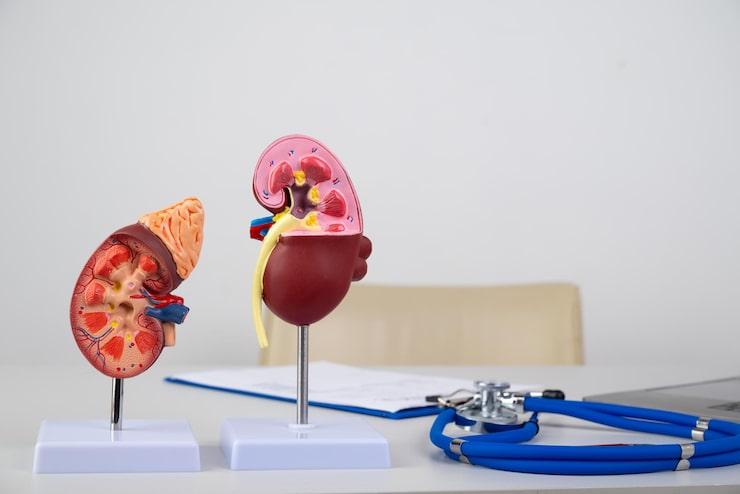
Learn the basics of kidney stone removal to be prepared with the guidance of the best in the field from Prakash Hospital.
14 Aug 2025
by Prakash Hospital
Answers to common questions about Haemodialysis at Prakash Hospital, Noida.


Book a consultation with Prakash Hospital's specialists — 24/7 emergency care, 100+ doctors, NABH accredited.
View All Departments