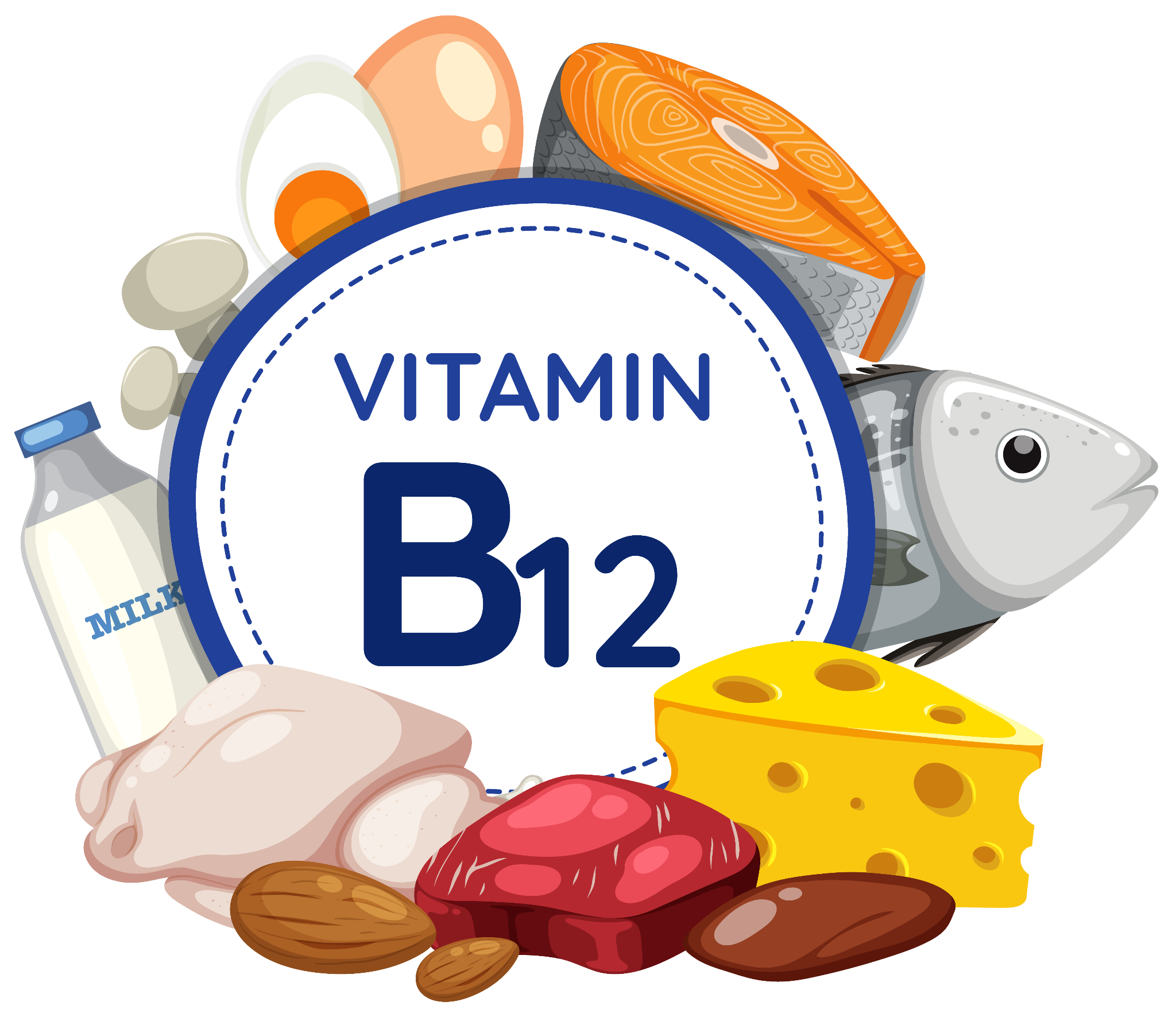
Vitamin B12 icon surrounded by healthy foods such as fish, eggs, and dairy to maintain nerve function, boosts energy levels and support mood balance, preventing deficiency-related health issues.
Vitamin B12 deficiency is among the most common and most underdiagnosed nutritional deficiencies in India. Studies suggest that 47–82% of Indian vegetarians and approximately 40–45% of urban Indian adults overall have inadequate B12 levels. Yet most people have never had their B12 checked, and the symptoms — which develop insidiously over months to years — are often attributed to stress, anaemia, or aging.
B12 is a remarkable vitamin: the human body stores 2–3 years' worth in the liver, which means deficiency takes months to years to manifest even after dietary B12 has been eliminated. By the time symptoms appear, stores are significantly depleted.
B12 (cobalamin) is involved in two fundamental cellular processes:
DNA synthesis: B12 is required for the folate pathway that enables DNA replication. Without adequate B12, cells that divide rapidly — blood cells, gut lining cells, nerve-supporting cells — cannot replicate normally. In blood cells, this produces megaloblastic anaemia (large, immature red blood cells that can't carry oxygen normally).
Myelin synthesis: B12 is essential for producing myelin — the fatty sheath that insulates nerve fibres and enables rapid nerve signal conduction. B12 deficiency progressively damages the myelin sheath, producing the neurological symptoms that are among the most serious consequences.
Methyl group metabolism: B12 is required as a cofactor in converting homocysteine to methionine. B12 deficiency raises homocysteine levels — an independent cardiovascular risk factor.
Vegetarians and vegans: B12 is found almost exclusively in animal-source foods — meat, fish, eggs, dairy. Plant foods contain no B12 (certain algae like nori contain negligible amounts; fermented foods contain small variable amounts from bacterial production). Vegetarians who consume dairy and eggs may maintain borderline B12 levels, but true vegans are at highest risk.
People on metformin: metformin (extremely commonly prescribed in India for type 2 diabetes and PCOD) reduces B12 absorption in the ileum by interfering with the calcium-dependent uptake mechanism. Long-term metformin users should have B12 checked annually.
Elderly adults: gastric acid production declines with age (achlorhydria), and B12 from food requires acid for release and absorption. The elderly also produce less intrinsic factor (see below). B12 deficiency is common in those above 60.
People with autoimmune gastritis / pernicious anaemia: intrinsic factor — produced by gastric parietal cells — is essential for B12 absorption in the ileum. Autoimmune destruction of parietal cells (autoimmune gastritis) prevents intrinsic factor production and causes pernicious anaemia, requiring B12 injections (oral B12 won't absorb).
People on proton pump inhibitors (PPIs) long-term: PPIs (omeprazole, pantoprazole) reduce stomach acid, impairing B12 release from food proteins. Very commonly prescribed in India and commonly taken without medical review for years.
People who have had gastric surgery: partial gastrectomy, gastric bypass, or bariatric surgery all reduce B12 absorption through reduced intrinsic factor and reduced acid.
Infants of B12-deficient mothers: breast-fed infants of vegan or severely B12-deficient mothers receive inadequate B12 through breast milk. B12 deficiency in infants causes severe and potentially irreversible neurological damage.
Symptoms develop slowly — often over 1–3 years as liver stores deplete.
Tingling and numbness: pins and needles in the hands and feet — often the earliest neurological symptom. The subacute combined degeneration of the spinal cord (SACD) from B12 deficiency begins with sensory symptoms.
Weakness in the limbs: progressive weakness, particularly in the legs. Difficulty walking, reduced coordination.
Balance problems and difficulty walking: damage to the posterior columns of the spinal cord (which carry proprioception — the sense of where the limbs are in space) causes unsteadiness, particularly in the dark when visual compensation is reduced.
Memory and cognitive problems: B12 deficiency impairs cognitive function — poor short-term memory, difficulty concentrating, "brain fog." This is reversible if caught early; it may become permanent with prolonged severe deficiency.
Mood changes: depression, irritability, and personality changes are documented in B12 deficiency. The relationship between B12 and neuropsychiatric function is well established.
Vision disturbances: optic nerve involvement can cause blurred or disturbed vision in severe deficiency.
Fatigue and weakness: megaloblastic anaemia produces fatigue, breathlessness on exertion, and reduced exercise tolerance — similar to iron deficiency anaemia but with a different mechanism.
Pallor: pale skin, pale mucous membranes (inner eyelids, gums).
Shortness of breath: from anaemia — the heart works harder to compensate for reduced oxygen-carrying capacity.
Rapid heartbeat (palpitations): compensatory increase in cardiac output.
Mouth and tongue changes:
Jaundice (mild): megaloblastic anaemia causes premature destruction of immature red blood cells within the bone marrow, releasing bilirubin and causing mild yellowing of the skin.
Elevated homocysteine: this is a blood marker rather than a clinical symptom, but elevated homocysteine from B12 deficiency is associated with increased cardiovascular and thrombotic risk.
Infertility: B12 deficiency impairs DNA synthesis and cell division — relevant to egg quality and implantation.
Serum B12: the standard screening test. Normal range varies by laboratory but typically 200–900 pg/mL. B12 below 200 pg/mL is deficient; 200–300 pg/mL is borderline — many people in this range have functional deficiency.
Homocysteine and methylmalonic acid (MMA): more sensitive markers of functional B12 deficiency — elevated even when serum B12 is in the low-normal range. Requested when B12 is borderline or symptoms suggest deficiency despite "normal" B12.
Complete blood count (CBC): macrocytosis (large red blood cells, elevated MCV) and hypersegmented neutrophils on blood film are classic B12 deficiency findings.
For dietary B12 deficiency (vegetarians, vegans, elderly):
Oral B12 supplementation is effective. Despite common belief, oral B12 in high doses (500–1,000 mcg daily) is absorbed even without intrinsic factor through passive diffusion — approximately 1% of any dose is absorbed this way, and high doses compensate.
Starting doses: 500–1,000 mcg daily for 1–3 months to replenish stores, then 250–500 mcg daily for maintenance.
Oral B12 may not be sufficient if intrinsic factor is absent. Intramuscular (IM) B12 injections bypass the absorption problem:
B12 is not reliably found in plant foods. For non-vegetarians, animal foods provide adequate B12 with regular consumption:
Best sources:
For vegetarians, the dairy and egg content must be consciously included and generous. Many vegetarians who "eat curd and milk" still have B12 deficiency if quantities are insufficient or absorption is impaired.
B12-fortified foods: some plant milks, breakfast cereals, and nutritional yeasts are fortified with B12 — useful for vegans if consumed in adequate quantities. Check labels for B12 content per serving.
At Prakash Hospital Noida, our physicians routinely check B12 alongside other relevant tests — particularly in vegetarians, those on metformin, the elderly, and anyone with fatigue, neurological symptoms, or anaemia. B12 injections are available for those requiring intramuscular replacement.
Whether you live in Sector 18, Sector 62, Greater Noida West, or anywhere in the NCR, Prakash Hospital Noida is a trusted name for vitamin B12 deficiency, nutrition assessment, and general medicine in Noida.
Tags: #VitaminB12Deficiency #B12DeficiencyIndia #PrakashHospitalNoida

We offer expert care across key specialties, including Medicine, Cardiology, Orthopaedics, ENT, Gynaecology, and more—delivering trusted treatment under one roof.


Book a consultation with Prakash Hospital's specialists — 24/7 emergency care, 100+ doctors, NABH accredited.

Prakash Hospital Pvt. Ltd. is a 100 bedded NABH NABL accredited multispecialty hospital along with a center of trauma and orthopedics. We are in the service of society since 2001.
OUR SPECIALITIES
Patient Services
PROCEDURES
Contact Us
D – 12A, 12B, Sector-33, G. B. Nagar, Noida, Uttar Pradesh 201301
+91-8826000033


© 2026 All rights reserved.
Designed and Developed by Zarle Infotech