


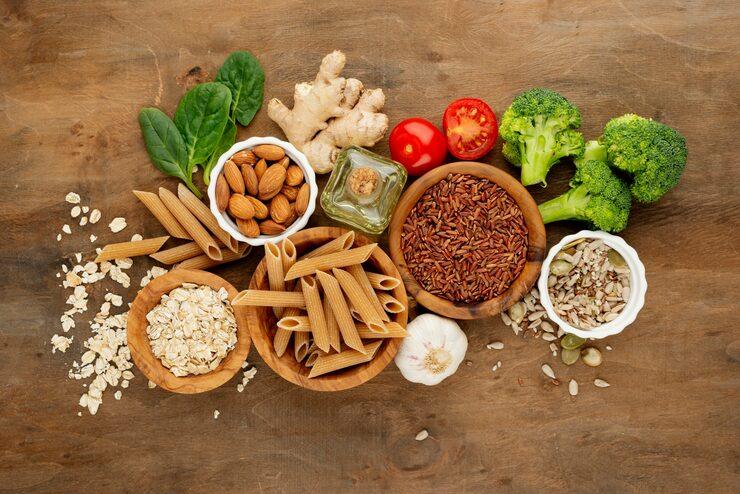
Why Fiber Is Good For Your Health And How It Helps Your Digestion
Learn the importance of dietary fiber for digestion, heart health, and immunity with expert-backed insights from Prakash Hospital, Noida.
15 Sept 2025
by Prakash Hospital
Repairs a weak spot in the abdominal wall, usually with a mesh, to get rid of the bulge and the risk of bowel getting trapped in it.

A hernia usually shows up as a soft bulge that appears when you stand, cough or lift, and slips back when you lie down. In the groin it can feel like a dragging ache by the end of the day. It won't go away on its own, because the gap in the muscle it's pushing through doesn't heal by itself.
That gap in the muscle wall of the abdomen lets fat or a loop of bowel push outward. The common types are inguinal (in the groin, far more common in men), femoral (lower in the groin, more common in women), umbilical (at or near the navel), epigastric (above the navel) and incisional (through an old surgical scar, such as a C-section). Hernia repair pushes the contents back and closes the gap. In most adults the repair is reinforced with a mesh, a flat sheet of medical-grade material that your own tissue grows into.
Mesh has made hernias far less likely to come back than stitches alone. Most people are back to light work within a week or two, though a few in 100 hernias return over the years.
Repairs of inguinal, umbilical and ventral hernias are among the operations our general surgery department performs most often, by keyhole (laparoscopic) or open surgery depending on your hernia. When the time is right, our physiotherapy team helps you rebuild core strength.
Not every hernia needs an operation straight away, but most eventually do. Surgery is advised when a hernia causes symptoms, keeps growing, or is a type likely to trap bowel.
For groin hernias, the surgeon places the mesh behind the muscle wall from the inside, through three small cuts. The two common methods are TEP, which stays outside the lining of the abdomen, and TAPP, which goes through it. It suits hernias on both sides, hernias that came back after open repair, and people who want a faster return to work.
A cut of about 6 to 8 cm is made over a groin hernia and the mesh is stitched over the weak area (the Lichtenstein repair). It can be done under spinal or even local anaesthetic, which helps older patients and people with heart or lung problems, and it's often preferred for very large hernias that reach into the scrotum.
Navel hernias under about 1 cm can be closed with stitches alone. Larger ones, and most incisional hernias, are repaired with mesh by keyhole or open surgery. A child's groin hernia is repaired without mesh by tying off the sac (herniotomy), usually as day care.
Keyhole repair is done under general anaesthesia. Open repair can be done under spinal or general anaesthesia, or a local anaesthetic with sedation.
For keyhole surgery, three small cuts are made near the navel and the space behind the muscle wall is opened up with gas. For open repair, one cut is made over the hernia.
The hernia sac with its fat or bowel is freed and pushed back into the abdomen. Any bowel that was trapped is checked to make sure it's healthy.
A mesh that overlaps the weak area by a good margin is laid in place and fixed with a few stitches, tacks or glue, or held by the pressure of the surrounding tissue.
The cuts are closed with dissolvable stitches. A groin repair takes about 45 to 90 minutes, and a large incisional hernia can take two hours or more.
You're up and walking within hours. Most groin repairs go home the same day or the next morning, and large incisional repairs stay 2 to 3 days. Hold a small pillow against the wound when you cough or sneeze.
Walk several times a day. Keep stools soft with water, fruit and fibre, and don't strain on the toilet. On an Indian toilet, squat slowly and hold a rail or the wall to get up.
Most people return to desk work and short drives. The stitches dissolve, and the surgeon checks the wound at your follow-up visit.
Heavy lifting, gym work and manual labour usually resume at around 4 to 6 weeks for groin hernias, and later after large incisional repairs.
Call us on +91-8826000033 or come straight to our 24/7 emergency department.
A small groin hernia in a man that causes little discomfort can be watched, as long as you know the signs of a trapped hernia. Most eventually become painful and need repair. Femoral hernias shouldn't be watched.
A belt or truss can hold a groin hernia in while you wait for surgery or if you're not fit for an operation. It doesn't close the gap, and it can rub the skin sore with long use.
A hiatus hernia is when part of the stomach slides up through the diaphragm into the chest. It causes acidity and heartburn rather than a bulge, shows up on an upper GI endoscopy, and is usually treated with medicines first.
Talk to our General & Laparoscopic Surgery team
Ask about your options, the cost and your insurance before you decide. See the insurance and TPA panels we work with.
This page explains Hernia Repair Surgery (Laparoscopic and Open) in general terms. Your own plan depends on your health, your test results and your doctor's advice. Please read our medical disclaimer.
Hernia Repair Surgery (Laparoscopic and Open) is led by our General & Laparoscopic Surgery team, with other departments stepping in at each stage of your care.
At Prakash Hospital, our General Surgery Department delivers expert surgical care for a wide range of conditions, combining advanced techniques with personalized treatment plans to ensure safe, effective, and faster recovery for our patients.
What the department treats
Laparoscopic Surgery
Hernia Repair
Gallbladder Surgery
Appendectomy
Thyroid Surgery
Wound Management
Guides walking, breathing and core-strengthening exercises so you return to lifting without straining the repair.
Controls diabetes, blood pressure and chronic cough before surgery to lower the risk of infection and recurrence.
Treats an enlarged prostate if straining to pass urine is part of what caused the hernia.
Procedures often considered alongside Hernia Repair Surgery (Laparoscopic and Open), or that treat related conditions.
Removes a gallbladder with stones through four small cuts, usually with a stay of one night or less.
Removes an inflamed appendix through three small cuts, usually with one or two nights in hospital.
Trims an enlarged prostate from inside the urethra so urine flows freely, with no cut on the skin.
A camera test of the food pipe, stomach and duodenum for acidity, ulcers, bleeding and swallowing problems.
Other procedures our General & Laparoscopic Surgery team performs.
Removes large or prolapsing piles that haven't settled with diet, medicines or banding.
Removes part or all of the thyroid for a goitre, a suspicious nodule or an overactive gland.
Removes a breast lump after tests, usually as day care, and sends it to the lab to confirm what it is.
Treats wounds that won't heal, from diabetic foot ulcers to bedsores, with debridement, dressings and pressure relief.
We offer expert care across key specialties, including Medicine, Cardiology, Orthopaedics, ENT, Gynaecology, and more—delivering trusted treatment under one roof.
Free tools to check your weight, plan a pregnancy, track calories and more.
Learn the importance of dietary fiber for digestion, heart health, and immunity with expert-backed insights from Prakash Hospital, Noida.
15 Sept 2025
by Prakash Hospital

Learn all about a special diet that will prepare your children for winter with advice from the experts at Prakash hospital, Noida.
3 Nov 2025
by Prakash Hospital

Learn about intestinal pain, its causes, warning signs, associated symptoms, and when to seek medical attention.
13 Feb 2026
by Prakash Hospital

Learn what atherosclerosis is, how plaque builds up in arteries, its causes, symptoms, risk factors, and how to prevent heart attack and stroke
6 Mar 2026
by Prakash Hospital

जानिए लो हीमोग्लोबिन का दिल की सेहत पर क्या प्रभाव पड़ता है। इसके कारण, लक्षण और समय पर इलाज व सही खानपान से कैसे बचाव किया जा सकता है, सरल भाषा में समझें।
6 May 2026
by Prakash Hospital

Leg pain while walking, cold feet, slow-healing wounds, these could be early signs of Peripheral Artery Disease. Prakash Hospital's vascular specialists in Noida explain what to watch for and when to act.
6 Apr 2026
by Prakash Hospital
Answers to common questions about Hernia Repair Surgery (Laparoscopic and Open) at Prakash Hospital, Noida.


Book a consultation with Prakash Hospital's specialists — 24/7 emergency care, 100+ doctors, NABH accredited.
View All Departments