


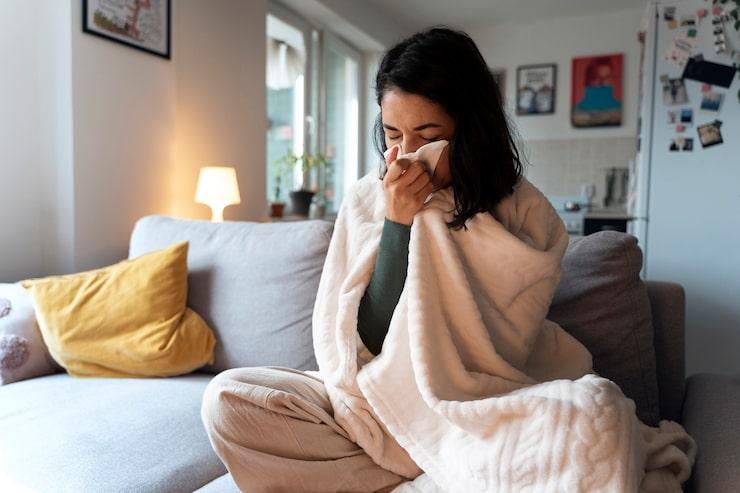
Common Cold: Symptoms, Home Remedies, and How to Recover
Common cold treatment, home remedies, and how to recover faster. Know when a cold becomes something more. Visit Prakash Hospital Noida for consultation.
17 Jun 2026
by Prakash Hospital
by By Prakash Hospital

Thirst, dark urine and dizziness on standing are early signs, and most mild cases improve with ORS sipped steadily at home.
For mild dehydration, the fastest safe treatment at home is oral rehydration solution (ORS), sipped steadily. Packets from a chemist are best. If none are available, mix 6 level teaspoons of sugar and half a teaspoon of salt in one litre of clean, boiled and cooled water. Give small sips every few minutes, continue after each loose stool or vomit, and rest in a cool place. If there is confusion, fainting, no urine for 8 hours, a very fast pulse, or you cannot keep fluids down, go to hospital.
Plain water helps, but it does not replace the salts lost in sweat, vomiting or diarrhoea, and ORS works better because glucose helps the gut absorb sodium and water together. This guide explains how to judge how dehydrated someone is, what to drink, what to avoid, how to care for children and older adults, and when home treatment isn't enough.
Dehydration happens when the body loses more water and salts than it takes in. Common causes in India include:
Home treatment is usually enough.
Start ORS at once and watch closely. Many people with moderate dehydration need medical review, especially children, older adults and anyone who is vomiting.
This is an emergency. Go to hospital immediately. Intravenous fluids may be needed.
Look for:
Infants and young children can become dehydrated quickly. Seek medical care early.
Buy a WHO-standard ORS sachet and mix it exactly as printed, in the stated volume of clean water. The reduced-osmolarity formula recommended by WHO provides, per litre: sodium chloride 2.6 g, trisodium citrate 2.9 g, potassium chloride 1.5 g and glucose 13.5 g. Do not add extra sugar, salt or fruit juice, and do not dilute with more water than directed. Too much sugar can worsen diarrhoea; too little salt does not replace losses.
Use the solution within 24 hours of mixing and store it covered. Discard anything left after that.
If you cannot get a sachet quickly:
Stir until dissolved. Measure carefully with level spoons. A salty or sweet taste far beyond what's described means the mix is wrong. It is better than plain water, but not as precisely balanced as a packet, so use a packet when you can.
Do not use a home recipe for a newborn without a doctor's advice.
Once you can drink and the worst is over, add:
Don't withhold food for long. Eating normally during diarrhoea, as soon as you can, helps recovery.
During Delhi NCR summers, outdoor workers, travellers and older people are at risk of heat exhaustion and heatstroke.
If you don't pass urine within 6 to 8 hours of starting ORS, or you are getting worse, go to a doctor.
Sip ORS steadily, rest in a cool place, add other fluids as tolerated and eat light food. If symptoms are severe, go to hospital.
ORS is best. Coconut water, buttermilk, rice water and dal water are good additions.
Mild dehydration usually improves within a few hours of proper fluids. Moderate cases may take a day. Severe cases need hospital treatment.
Mild cases from not drinking enough can be fixed with water. After diarrhoea, vomiting or heavy sweating, ORS is better because it replaces salts too.
One litre of clean water, 6 level teaspoons of sugar and half a teaspoon of salt. Stir well.
Sports drinks have more sugar and less sodium than ORS and are not designed for diarrhoeal dehydration. They are fine for light exercise but not a replacement.
If there is confusion, fainting, no urine for 8 hours, rapid heartbeat, inability to keep fluids down, blood in stool or vomit, or any severe signs. Take babies and young children early.
See a doctor if diarrhoea lasts more than two days, if you have a high fever, blood in the stool, severe belly pain, or if a baby, child, older person, pregnant woman or someone with a chronic illness is dehydrated. Seek emergency care for the severe signs listed above.
Whether you live in Sector 18, Sector 62, Greater Noida West, or anywhere nearby, Prakash Hospital Noida is a trusted name for emergency and general medicine care in Noida. Our team can assess dehydration quickly and give intravenous fluids when needed.
To book a consultation, call the number.
Sources: World Health Organization reduced-osmolarity ORS formulation (as summarised on WikEM). Home-made ORS recipe as published in standard emergency medicine references.
Tags: #TreatDehydration #ORSRecipe #PrakashHospitalNoida

Blocks or removes the fallopian tubes for permanent contraception, usually as day-care keyhole surgery.
Keyhole surgery using a thin camera to diagnose and repair problems inside the knee or shoulder.
Delivers the baby through a low cut in the abdomen and uterus, planned or in labour, usually under spinal anaesthesia.
Free tools to check your weight, plan a pregnancy, track calories and more.
We offer expert care across key specialties, including Medicine, Cardiology, Orthopaedics, ENT, Gynaecology, and more—delivering trusted treatment under one roof.
Common cold treatment, home remedies, and how to recover faster. Know when a cold becomes something more. Visit Prakash Hospital Noida for consultation.
17 Jun 2026
by Prakash Hospital

सर्जरी के बाद जल्दी रिकवरी कैसे करें? जानिए सही देखभाल, खानपान, आराम और सावधानियाँ जो जल्दी ठीक होने में मदद करती हैं।
11 Feb 2026
by Prakash Hospital

जानिए बच्चों में मोबाइल और टीवी की लत क्यों लगती है, इसके नुकसान क्या हैं और इसे कम करने के प्रभावी तरीके क्या हैं।
28 Apr 2026
by Prakash Hospital

Discover what causes insulin resistance and how diet, exercise, sleep, and lifestyle changes can help you take control of your health
9 Apr 2026
by Prakash Hospital

HOMA-IR equals fasting glucose times fasting insulin divided by 405. See worked examples, what the ranges mean, how to prepare and how to improve your score.
15 Oct 2026
by Prakash Hospital

जानिए थायरॉइड टेस्ट कब करवाना चाहिए, किन लक्षणों में जांच जरूरी है, और कौन-कौन से टेस्ट होते हैं। सही समय पर Prakash Hospital से संपर्क करें।
2 Mar 2026
by Prakash Hospital


Book a consultation with Prakash Hospital's specialists — 24/7 emergency care, 100+ doctors, NABH accredited.
View All Departments