
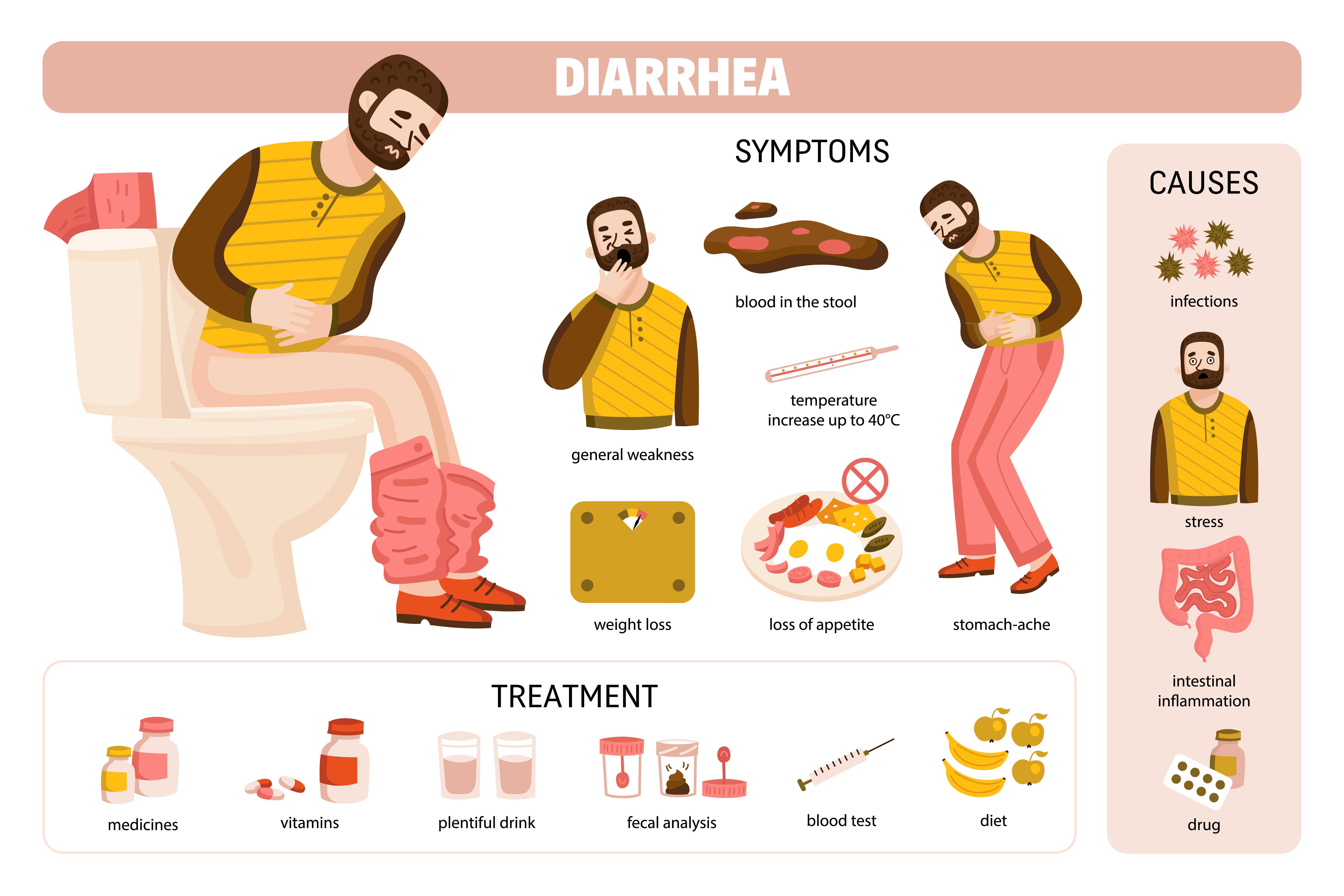
Infographic showing IBS symptoms like bloating, pain, constipation, and diarrhoea.
Diarrhoea is the passage of loose, watery stools three or more times in 24 hours. It's one of the most common medical complaints worldwide, and in India — where contaminated water, food-handling practices, and seasonal infections create year-round exposure — it's something most adults experience several times a year.
Most diarrhoea is self-limiting and manageable at home. The most important intervention in most cases is oral rehydration — replacing the fluid and electrolytes lost. But some diarrhoea is a sign of something serious, and the red flags that distinguish the two are worth knowing clearly.
Acute diarrhoea: lasting less than 14 days. Most common type. Usually infectious.
Persistent diarrhoea: lasting 14–29 days. Warrants medical evaluation.
Chronic diarrhoea: lasting 30 days or more. Requires investigation for underlying cause.
Secretory diarrhoea: large-volume, watery stools from secretion of fluid and electrolytes into the gut lumen. Characteristic of cholera, certain bacterial toxins.
Osmotic diarrhoea: from poorly absorbed solutes drawing water into the gut. Characteristic of lactose intolerance, sorbitol, or malabsorption.
Inflammatory diarrhoea (dysentery): bloody and/or mucus-containing stool from intestinal inflammation. Characteristic of bacterial dysentery (Shigella, Salmonella, E. coli O157) or amoebic dysentery.
The vast majority of acute diarrhoea is infectious.
Viral: norovirus, rotavirus, adenovirus. The most common causes globally. Self-limiting, typically 24–72 hours. No vomiting of blood, no significant fever, no blood in stool.
Bacterial food poisoning: Salmonella, Campylobacter, E. coli, Staphylococcal toxin (rapid onset — within hours of eating). Can be more severe, with fever and sometimes blood in stool.
Amoebic dysentery: Entamoeba histolytica. Produces the classic red-and-white (blood and mucus) stool. Often accompanied by right lower abdominal pain and tenesmus. Does not resolve without specific treatment (metronidazole/tinidazole).
Cholera: profuse, watery ("rice-water") stools with rapid dehydration. A medical emergency — requires immediate IV rehydration. Less common in urban India with treated water supplies but still occurs in outbreaks.
Traveller's diarrhoea: onset within 1–2 weeks of travel; usually E. coli (ETEC) or other bacteria from locally contaminated food or water.
IBS with diarrhoea (IBS-D): recurrent, not associated with infection; linked to gut motility dysfunction and visceral hypersensitivity. Often stress-triggered.
Lactose intolerance: diarrhoea and bloating 30 minutes to 2 hours after dairy products. Very common in India.
Medications: antibiotics (particularly ampicillin, clindamycin) cause diarrhoea by disrupting gut bacteria; magnesium-containing antacids; metformin; sorbitol-containing medications.
Coeliac disease: gluten-triggered immune response causing chronic diarrhoea with malabsorption.
Inflammatory bowel disease (Crohn's, ulcerative colitis): chronic or recurrent diarrhoea, often with blood, accompanied by abdominal pain and weight loss.
Thyroid disease: hyperthyroidism increases gut motility and causes diarrhoea.
Anxiety and stress: the gut-brain axis produces diarrhoea with acute stress (exam diarrhoea, interview diarrhoea) through direct autonomic nervous system effects.
The greatest risk from acute diarrhoea is dehydration — from fluid and electrolyte loss. Particularly dangerous in infants, young children, the elderly, and people with chronic illness.
ORS (Oral Rehydration Solution): the WHO-formulated ORS sachet dissolved in one litre of boiled and cooled water is the single most effective intervention for diarrhoea worldwide. It contains the precise sodium-glucose ratio (65 mmol/L sodium, 75 mmol/L glucose) that activates the sodium-glucose cotransporter in the gut — allowing maximum fluid absorption even when the gut is inflamed. This mechanism was described as one of the most important medical advances of the 20th century.
Available at every pharmacy in India. Inexpensive. Should be in every home.
How to give ORS:
Coconut water: an effective oral rehydration fluid in mild diarrhoea. Contains natural electrolytes — particularly potassium — and is isotonic. Not a substitute for ORS in severe dehydration but excellent for mild cases.
Rice water (kanji/maand): the starchy water from boiling rice provides glucose and some electrolytes. Traditional and effective for mild diarrhoea rehydration.
Avoid: undiluted fruit juice (too much sugar draws water into the gut, worsening diarrhoea), plain water without electrolytes for severe dehydration (doesn't replace sodium adequately), carbonated drinks (gas worsens cramping).
Mild: increased thirst, dry mouth, slightly dark urine.
Moderate: dark yellow to amber urine; urinating infrequently; dizziness on standing; dry eyes and mouth.
Severe (requires medical care): no urine in 6–8 hours; extreme weakness; very dry skin (pinched skin doesn't spring back immediately); rapid heart rate; confusion; cool/clammy skin.
In children: sunken fontanelle (soft spot in infants); no tears when crying; very dry nappy; extreme listlessness.
The outdated advice to fast during diarrhoea has been revised. Eating plain, easily digestible food maintains gut lining integrity and supports recovery.
Safe foods:
Avoid during acute diarrhoea:
The BRAT diet (Bananas, Rice, Applesauce, Toast) is a traditional Anglo-American approach to diarrhoea diet. The Indian equivalent — khichdi, banana, plain rice, and plain roti — achieves the same principle: starchy, low-fibre, low-fat, easy to digest.
Loperamide (Imodium/Lopamide): reduces gut motility, slowing diarrhoea. Appropriate for watery non-infectious diarrhoea (traveller's diarrhoea, IBS-D) when there is no fever and no blood in stool. NOT appropriate when blood is in the stool, when fever is significant, or when amoebic or bacterial dysentery is suspected — slowing gut motility traps pathogen toxins in the gut and can worsen these conditions.
Probiotics (Saccharomyces boulardii, Lactobacillus rhamnosus GG): evidence-based for reducing duration of acute infectious diarrhoea in children and adults. A probiotic supplement taken alongside ORS shortens diarrhoea duration by approximately 1 day in clinical trials. Plain curd provides some probiotic benefit.
Zinc supplementation (in children under 5): WHO and India's National Health Mission recommend 10–20 mg of zinc daily for 10–14 days alongside ORS in children with diarrhoea. Reduces severity, duration, and risk of subsequent episodes for the following 2–3 months. Evidence is robust.
Antibiotics: should NOT be taken routinely for diarrhoea without medical evaluation. Viral diarrhoea — the most common type — doesn't respond to antibiotics. Inappropriate antibiotics worsen some bacterial diarrhoeas (particularly certain E. coli strains). Antibiotics are appropriate for confirmed bacterial dysentery (azithromycin for Shigella, Salmonella), cholera (azithromycin, doxycycline), typhoid, and metronidazole/tinidazole for amoebic dysentery and giardiasis.
At Prakash Hospital Noida, our physicians evaluate diarrhoea — stool microscopy and culture, blood tests, IV rehydration for significant dehydration, and specific treatment for amoeba, bacterial infections, and other causes.
Whether you live in Sector 18, Sector 62, Greater Noida West, or anywhere in the NCR, Prakash Hospital Noida is a trusted name for diarrhoea treatment, digestive health, and general medicine in Noida.
 Copy
CopyWe offer expert care across key specialties, including Medicine, Cardiology, Orthopaedics, ENT, Gynaecology, and more—delivering trusted treatment under one roof.
Dr. Megha
Dr. R.C. Sharma
Dr. Divyajyoti Sharma


Book a consultation with Prakash Hospital's specialists — 24/7 emergency care, 100+ doctors, NABH accredited.

Prakash Hospital Pvt. Ltd. is a 100 bedded NABH NABL accredited multispecialty hospital along with a center of trauma and orthopedics. We are in the service of society since 2001.
OUR SPECIALITIES
Patient Services
PROCEDURES
Contact Us
D – 12A, 12B, Sector-33, G. B. Nagar, Noida, Uttar Pradesh 201301
+91-8826000033


© 2026 All rights reserved.
Designed and Developed by Zarle Infotech


