


Period Pain Relief: Natural Remedies for Menstrual Cramps
Discover effective natural remedies for period pain relief, including lifestyle tips, home treatments, and ways to ease menstrual cramps safely.
28 Apr 2026
by Prakash Hospital
by By Prakash Hospital

Subtracting 14 from your cycle length estimates your ovulation day: day 16 in a 30-day cycle.
To estimate your ovulation day, subtract 14 from the length of your cycle. A 28-day cycle gives day 14, a 32-day cycle gives day 18, and a 24-day cycle gives day 10. The reason is that the time between ovulation and your next period (the luteal phase) is fairly steady at around 14 days, while the first half of the cycle is the part that stretches or shrinks. Day 1 is the first day of bleeding.
This is an estimate, not a measurement. Even in women with regular periods, ovulation can move by several days from one month to the next. The rest of this guide gives you calendar examples, a method for irregular cycles, the body signs and tests that tell you when ovulation is really happening, and the situations when the arithmetic won't work.
Ovulation day = cycle length − 14
Count cycle length from the first day of one period to the day before the next period starts.
| Cycle length | Estimated ovulation day | |---|---| | 24 days | Day 10 | | 26 days | Day 12 | | 28 days | Day 14 | | 30 days | Day 16 | | 32 days | Day 18 | | 35 days | Day 21 |
The luteal phase begins at ovulation and ends when the next period arrives. Studies of healthy women find it averages 12 to 14 days, with a normal range of about 10 to 16 days. Using 14 gives a workable average, but if your luteal phase is shorter or longer than that, your actual ovulation day shifts accordingly.
Say your last period started on 10 March 2026. Day 1 is 10 March, so day 14 is 23 March (add 13 days to the start date).
| Cycle length | Ovulation day | Calendar date | |---|---|---| | 24 days | Day 10 | 19 March 2026 | | 28 days | Day 14 | 23 March 2026 | | 30 days | Day 16 | 25 March 2026 | | 32 days | Day 18 | 27 March 2026 | | 35 days | Day 21 | 30 March 2026 |
In the 28-day example, your next period would start on 7 April (day 29, which is 10 March plus 28 days). If your own count is a day out, check whether you counted 10 March as day 1 or as day 0.
Cycle length varies. A single cycle tells you little. A better approach:
Example: cycles of 29, 31, 28, 30, 32 and 30 days add up to 180. The average is 30 days. Ovulation is estimated at day 16.
If your cycles vary by more than about 7 to 8 days (say from 25 to 36 days), an average is a weak guide, and the next method is better.
This old calendar method uses your shortest and longest cycles of the last six to find the range of days when ovulation might fall.
Example: shortest cycle 26 days, longest 32 days. First day = 26 − 18 = day 8. Last day = 32 − 11 = day 21. Your fertile window may therefore fall anywhere between days 8 and 21, a span of 14 days.
That range is wide, which shows the honest limit of the calendar. If your cycles are irregular, the calendar can only point to a broad zone, and tests or ultrasound do better.
In the days before ovulation, rising oestrogen makes cervical mucus clear, slippery and stretchy, much like raw egg white. After ovulation it turns thick, sticky or dries up. The most slippery day is usually the best sign that ovulation is close.
These urine strips detect the surge of luteinising hormone (LH) that triggers the egg's release. Ovulation usually follows within about 24 to 36 hours of a positive result. Start testing a few days before your expected ovulation day, and test around the same time each day. Very diluted urine can miss the surge, so avoid drinking a lot beforehand. Women with PCOS may get several positive-looking tests, because their baseline LH is high.
Your resting temperature rises by roughly 0.3 to 0.5 °C after ovulation, because of progesterone, and stays up until your next period. Measure with a sensitive thermometer at the same time every morning before getting out of bed. BBT confirms that ovulation has already happened; it doesn't predict it. It is most useful over a few cycles, when you can see a pattern and learn on which day of the cycle the rise usually comes.
Some women feel a brief ache or twinge on one side of the lower abdomen around ovulation. Not everyone feels it, and it's not reliable enough to time anything by.
A small rise in libido, mild breast tenderness, light spotting mid-cycle and a change in cervix position are reported by some. None is precise.
Serial vaginal scans show the dominant follicle growing (typically to about 18 to 24 mm before it ruptures) and then confirm that it has released the egg. This is the gold standard and is used in fertility evaluation and treatment.
A blood test about 7 days before the expected period shows whether ovulation occurred. Doctors use it when cycles are irregular or when someone is struggling to conceive.
Subtract 14 from your cycle length. For a 30-day cycle, ovulation falls around day 16.
Use the Ogino-Knaus method with your shortest and longest cycles, or better, use LH test strips and mucus observation. Ask for an ultrasound if you're struggling to conceive.
About day 14.
A rise in basal body temperature that stays up for at least three days, a positive LH test followed by a change in mucus, and a mid-luteal blood test or ultrasound all confirm it.
Yes. Many women have no symptoms. Ovulation tests and tracking are how most people find out.
Not in the usual sense. A woman can release more than one egg in the same 24 hour period, but it's rare to ovulate again later in the same cycle.
Typically 12 to 16 days, with 14 the average.
See a gynaecologist if your periods are irregular or absent, cycles are shorter than 21 days or longer than 35, you've been trying for 12 months without success (6 months if you're 35 or older), or you have symptoms of PCOS such as excess hair growth, acne and weight gain.
Whether you live in Sector 18, Sector 62, Greater Noida West, or anywhere nearby, Prakash Hospital Noida is a trusted name for gynaecology and fertility care in Noida. Our doctors can track ovulation with scans and blood tests and help you plan a pregnancy with confidence.
To book a consultation, call the number.
Sources: HealthLink BC, ovulation and fertility awareness resources. Wilcox AJ, Weinberg CR, Baird DD. Timing of sexual intercourse in relation to ovulation. New England Journal of Medicine, 1995.
Tags: #OvulationCalculator #HowToCalculateOvulation #PrakashHospitalNoida

This article covers gynaecology concerns. These Prakash Hospital doctors in Noida treat them.

Dr. Shachi Singh
Consultant Gynaecologist & Obstetrician
Obstetrics & High-Risk Pregnancy · Laparoscopic Surgery · Infertility Treatment

Dr. Priya Shikha Modi
Consultant Gynaecologist
Hysterectomies · Laparoscopic Hysterectomies · Gynecological Pathologies
Keyhole removal of an ovarian cyst that keeps the healthy ovary, usually with a stay of one night or less.
Delivers the baby through a low cut in the abdomen and uterus, planned or in labour, usually under spinal anaesthesia.
Treats the uterine lining to make heavy periods lighter or stop them, with no cuts, for women who want no more children.
Free tools to check your weight, plan a pregnancy, track calories and more.
We offer expert care across key specialties, including Medicine, Cardiology, Orthopaedics, ENT, Gynaecology, and more—delivering trusted treatment under one roof.
Discover effective natural remedies for period pain relief, including lifestyle tips, home treatments, and ways to ease menstrual cramps safely.
28 Apr 2026
by Prakash Hospital

Black or dark period blood is usually old blood leaving slowly, but not always. See a colour guide, common causes, infection signs and when to see a doctor.
13 Oct 2026
by Prakash Hospital
How to relieve period pain — from NSAIDs and heat packs to yoga and diet changes. When severe pain needs investigation. Prakash Hospital Noida.
21 Sept 2026
by Prakash Hospital
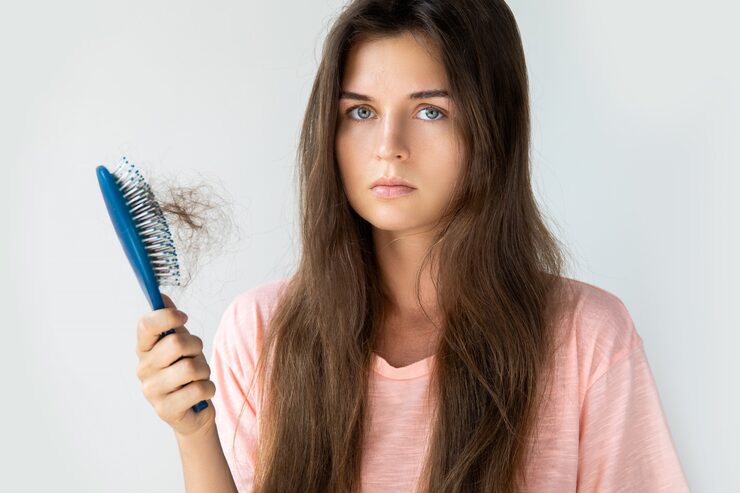
How to stop hair fall with diet, lifestyle changes, and proven treatments. Indian-specific guide from Prakash Hospital Noida.
1 Sept 2026
by Prakash Hospital

Does dandruff cause hair fall? The link between scalp inflammation and hair loss — and how to treat both. Prakash Hospital Noida.
7 Sept 2026
by Prakash Hospital

Which vitamin deficiencies cause hair fall — iron, vitamin D, B12, and zinc. How to test and fix them. Prakash Hospital Noida.
4 Sept 2026
by Prakash Hospital

जानिए PCOD और PCOS क्या हैं, दोनों में क्या अंतर है, इनके लक्षण, कारण और इलाज के बारे में विस्तार से।
30 Mar 2026
by Prakash Hospital
PCOD symptoms — recognise the early warning signs of polycystic ovarian disease and when to see a gynaecologist. Visit Prakash Hospital Noida for women's health care.
9 Jun 2026
by Prakash Hospital

PCOD problems — the long-term health complications of polycystic ovarian disease and how to prevent them. Visit Prakash Hospital Noida for expert care.
2 Jun 2026
by Prakash Hospital


Book a consultation with Prakash Hospital's specialists — 24/7 emergency care, 100+ doctors, NABH accredited.
View All Departments