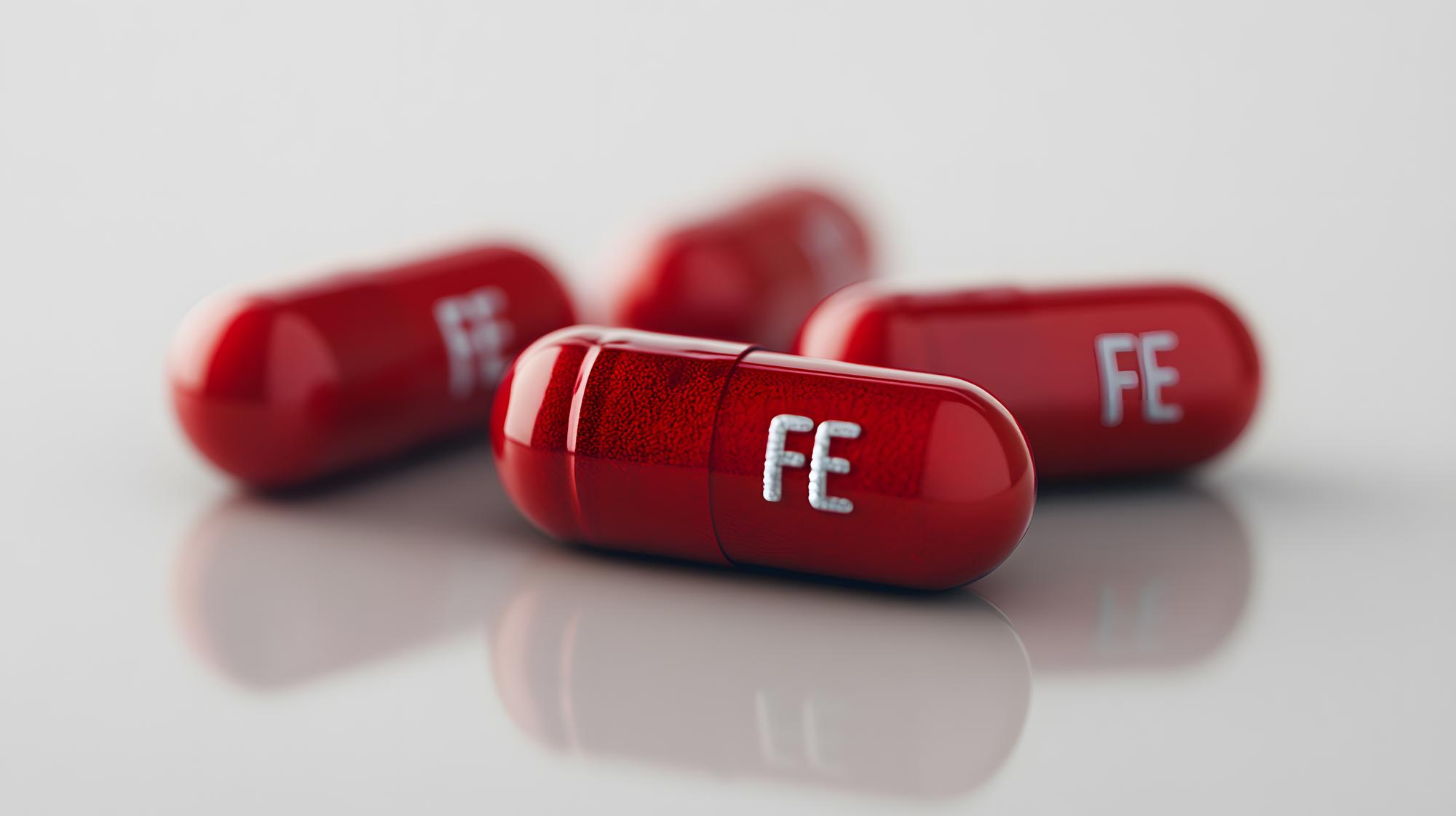
Close-up of red iron supplement tablets placed on a surface, representing oral iron medication commonly used to treat iron deficiency, anemia or fatigue.
Iron deficiency is the most common nutritional deficiency in the world — and India carries one of the heaviest burdens. An estimated 50–60% of women of reproductive age and 74% of children under five in India are anaemic, predominantly from iron deficiency. The consequences extend far beyond fatigue: iron deficiency impairs cognitive development, reduces work capacity, increases maternal mortality in pregnancy, and compromises immune function.
Understanding the symptoms, knowing who is at risk, and knowing what to do about it is genuinely important health knowledge for most Indians.
Haemoglobin: the oxygen-carrying protein in red blood cells. Each haemoglobin molecule contains four iron atoms, and iron is what allows it to bind and release oxygen. Without adequate iron, haemoglobin production falls, red blood cells become smaller and paler (microcytic, hypochromic), and the blood's oxygen-carrying capacity is reduced. This is iron deficiency anaemia.
Cellular functions: iron is also required by mitochondria (cellular energy production), immune cells, enzymes involved in DNA synthesis, and the thyroid gland. Even iron deficiency without anaemia (normal haemoglobin but low ferritin/iron stores) impairs these functions.
1.Iron depletion: ferritin (iron stores) falls, but haemoglobin and serum iron are still normal. No anaemia yet. Symptoms may already begin (fatigue, hair fall).
2.Iron-deficient erythropoiesis: iron stores are depleted; iron supply to the bone marrow falls; red blood cells being produced become smaller. Haemoglobin is still normal or borderline.
3.Iron deficiency anaemia: haemoglobin falls below normal. All the classic symptoms of anaemia are present.
This progression explains why checking only haemoglobin misses early iron deficiency — people in stages 1 and 2 have impaired function without technically being "anaemic."
The most universal symptom. Fatigue from iron deficiency is distinct from ordinary tiredness — it's persistent, disproportionate to the effort, and doesn't fully resolve with rest. The mechanism: reduced oxygen delivery to muscles means they generate energy less efficiently; the heart works harder to compensate, but overall aerobic capacity is reduced.
Many women in India accept chronic fatigue as "normal" without realising iron deficiency is the reversible cause.
Paleness of the skin, mucous membranes, and nail beds. Best assessed by pulling down the inner eyelid (conjunctiva) — the inner surface should be a healthy pink; in anaemia, it appears pale pink or white. Checking the palms and nail beds also shows pallor in moderate-severe anaemia.
In darker skin tones (common in India), pallor may not be immediately obvious in the face — the conjunctiva and palms are the most reliable sites.
Climbing stairs, walking briskly, or doing household work produces breathlessness that was not present before. This reflects the heart and lungs working harder to compensate for reduced oxygen-carrying capacity. In severe anaemia, breathlessness occurs at rest.
The heart beats faster to maintain oxygen delivery despite fewer functional red blood cells. This can be felt as palpitations — awareness of a fast or strong heartbeat. Persistent palpitations with other anaemia symptoms warrant medical evaluation, particularly to exclude cardiac causes.
Reduced oxygen to the brain causes headache — typically dull, diffuse, and worse with exertion.
Iron is required for dopamine metabolism in the brain and for myelination of nerve fibres. Even mild iron deficiency (without anaemia) impairs cognitive function — concentration, memory retrieval, and mental clarity. Students, working adults, and elderly people often notice significant improvement in mental sharpness after iron correction.
Poor peripheral circulation from reduced cardiac output in anaemia, and the body's response of directing blood flow preferentially to vital organs.
As discussed in the hair fall blogs — iron deficiency (particularly low ferritin even with normal haemoglobin) is the leading correctable cause of diffuse hair fall in Indian women.
An uncomfortable urge to move the legs, particularly at rest and at night — relieved by movement. Iron deficiency is one of the most common reversible causes of restless legs syndrome. Correcting iron often resolves or significantly reduces symptoms.
A craving for non-food substances — ice (pagophagia), clay, dirt, chalk, or starch. Unusual and characteristic of iron deficiency. If present, it strongly supports the diagnosis.
Cracks at the corners of the mouth (angular stomatitis) and inflammation of the tongue (glossitis — smooth, red, sore tongue). Iron is required for the rapid cell division of mucosal tissues.
Nails that become thin, brittle, and eventually develop a concave (spoon-shaped) appearance. A classic sign of severe, prolonged iron deficiency.
Iron-deficient individuals are more susceptible to infections — iron is required for normal immune cell function. Frequent infections (colds, urinary infections, skin infections) alongside other symptoms may indicate iron deficiency.
Women of reproductive age: monthly menstrual blood loss depletes iron regularly. Heavy periods (menorrhagia) — extremely common in India from fibroids, PCOD, hormonal imbalances — significantly increase blood and iron loss. Women with heavy periods and vegetarian diets are at particularly high risk.
Pregnant women: fetal and placental iron demands during pregnancy are substantial. Without adequate dietary iron and supplementation, maternal iron deficiency is almost inevitable.
Adolescent girls: rapid growth + onset of menstruation + often inadequate dietary iron = very high rates of deficiency in Indian adolescent girls.
Infants and young children: breast milk is low in iron (sufficient for the first 6 months if maternal stores are adequate, but not beyond). Introduction of iron-rich complementary foods at 6 months is essential. Iron deficiency in early childhood impairs brain development — including IQ — with consequences that persist.
Vegetarians: plant-based (non-haem) iron is absorbed at 2–20%, compared to haem iron from meat at 20–30%. The absorption varies with other dietary factors: vitamin C dramatically increases non-haem iron absorption; tannins (in tea/coffee), calcium, and phytates (in whole grains) reduce it.
People with gut absorption problems: coeliac disease, inflammatory bowel disease, H. pylori gastritis (impairs iron absorption).
People with chronic blood loss: peptic ulcers, haemorrhoids, parasitic infections (hookworm — common in rural India), and heavy menstruation all cause chronic blood loss depleting iron.
Haemoglobin (Hb): the initial test. Normal ranges: women above 12 g/dL; men above 13 g/dL; pregnant women above 11 g/dL.
Complete blood count (CBC): in iron deficiency anaemia, the MCV (mean corpuscular volume) is low (microcytic cells) and the MCH (mean corpuscular haemoglobin) is low (pale cells).
Serum ferritin: the most sensitive early marker of iron deficiency — depletes before haemoglobin falls. Normal above 12–15 ng/mL (varies by lab); for hair health, above 30–40 ng/mL is the target; for optimal health, above 50 ng/mL.
Serum iron and TIBC (Total Iron Binding Capacity): further characterises iron status. Low serum iron and high TIBC suggest iron deficiency.
Peripheral blood smear: shows microcytic, hypochromic red cells.
Non-haem iron (from plants) — requires vitamin C for maximum absorption:
Haem iron (from animal foods) — much better absorbed:
To improve plant iron absorption:
For moderate-to-severe iron deficiency anaemia, diet alone rarely corrects the deficiency fast enough.
Oral iron supplements:
Duration: at least 3 months after haemoglobin normalises to replenish ferritin stores. Many people stop when they "feel better" — this is too early.
IV iron (intravenous): for severe anaemia not tolerating oral iron, cases of malabsorption, or pregnancy where rapid correction is needed. Given in a hospital or clinic setting.
At Prakash Hospital Noida, our physicians evaluate iron deficiency and anaemia with complete blood count, serum ferritin, peripheral smear, and investigation for the underlying cause (particularly chronic blood loss). Dietary counselling and appropriate supplementation are provided, alongside IV iron where indicated.
Whether you live in Sector 18, Sector 62, Greater Noida West, or anywhere in the NCR, Prakash Hospital Noida is a trusted name for anaemia, iron deficiency, nutrition assessment, and general medicine in Noida.
Tags: #IronDeficiencySymptoms #AnaemiaIndia #PrakashHospitalNoida

This article covers general medicine concerns. These Prakash Hospital doctors in Noida treat them.

Dr. Birendra Pawar
Consultant Internal Medicine
Hysterectomies · Laparoscopic Hysterectomies · Gynecological Pathologies

Dr. Sunil P. Chaudhary
Consultant Internal Medicine
Diabetes · Hypertension · Thyroid Disorders
We offer expert care across key specialties, including Medicine, Cardiology, Orthopaedics, ENT, Gynaecology, and more—delivering trusted treatment under one roof.


Book a consultation with Prakash Hospital's specialists — 24/7 emergency care, 100+ doctors, NABH accredited.

Prakash Hospital Pvt. Ltd. is a 100 bedded NABH NABL accredited multispecialty hospital along with a center of trauma and orthopedics. We are in the service of society since 2001.
OUR SPECIALITIES
Patient Services
PROCEDURES
Contact Us
D – 12A, 12B, Sector-33, G. B. Nagar, Noida, Uttar Pradesh 201301
+91-8826000033


© 2026 All rights reserved.
Designed and Developed by Zarle Infotech