


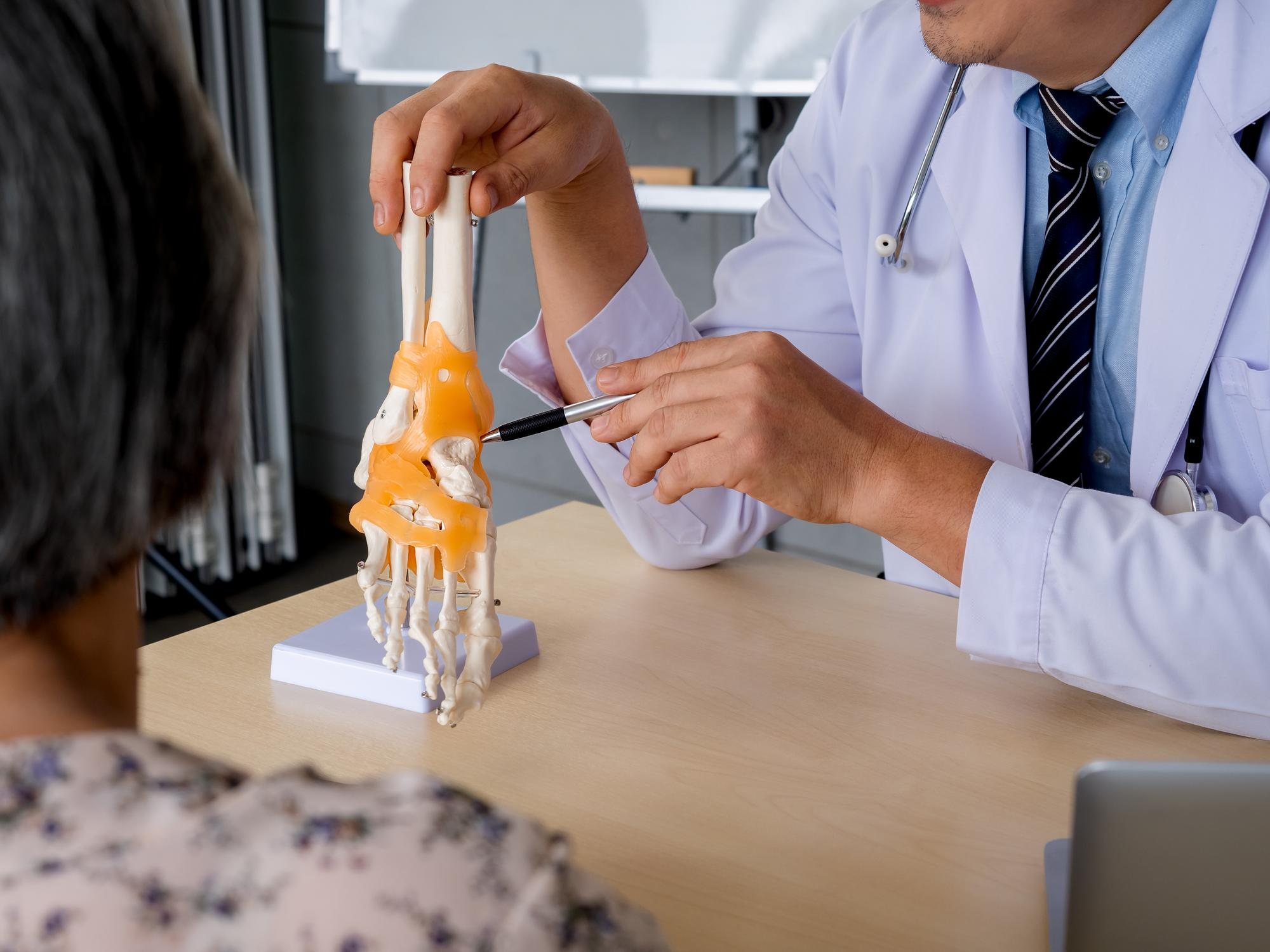
हड्डियों में सूजन (Bone Inflammation) क्यों होती है?
हड्डियों में सूजन के कारण, लक्षण और इलाज जानें। ऑस्टियोमाइलाइटिस, आर्थराइटिस और हड्डी के दर्द को नजरअंदाज न करें। Prakash Hospital में पाएं एडवांस ऑर्थोपेडिक उपचार।
9 Jun 2026
by Prakash Hospital
by By Prakash Hospital

Medical-grade bioimpedance devices with hand and foot electrodes estimate skeletal muscle far more reliably than bathroom scales.
You can't measure your muscle mass accurately at home. A DEXA scan or a good bioimpedance device gives the best estimates, and everything else is approximate. What you can do at home is test how much your muscle can actually do: how hard you can grip, how fast you can walk, how quickly you can stand up from a chair five times. Those tests predict health outcomes surprisingly well, and doctors use them alongside scans to diagnose muscle loss.
This guide explains what skeletal muscle mass is, how it's measured, what ranges are considered normal, where the Asian sarcopenia cut-offs sit, and what to do if you're low. It also explains why the muscle percentage on your smart scale probably doesn't match the one at the gym.
Your body has three kinds of muscle: cardiac muscle (the heart), smooth muscle (in the gut and blood vessels), and skeletal muscle, the type attached to bones that moves your body. Skeletal muscle mass is the combined weight of all your skeletal muscle.
It's a part of your lean body mass, not the whole. Lean mass also includes bone, organs, skin and the water in all of them. Skeletal muscle is usually somewhere between a third and a half of lean mass.
Skeletal muscle does far more than move you:
This is why losing muscle matters so much in older age, and why having more of it earlier in life is protective.
Muscle percentage is skeletal muscle mass divided by body weight, times 100.
Muscle % = (skeletal muscle mass ÷ body weight) × 100
Example: a man weighing 75 kg with 31 kg of skeletal muscle has a muscle percentage of 31 ÷ 75 × 100 = 41.3 percent.
Typical values depend heavily on the device and the way it estimates. As a rough guide, healthy young adults often fall in these bands on bioimpedance devices:
| | Typical skeletal muscle percentage | |---|---| | Men | About 38 to 46% | | Women | About 28 to 36% |
These are ballpark figures. They differ by device, brand and software. Don't compare your number against a table from a different machine. Compare it with your own earlier readings on the same device.
Dual-energy X-ray absorptiometry splits the body into fat, lean tissue and bone. It reports lean mass for each arm, each leg and the trunk. Adding up the arms and legs gives the appendicular lean mass, which is a good stand-in for skeletal muscle. This is the method most widely used in research and in diagnosing sarcopenia.
Uses a small electric current. It estimates total body water, lean mass and fat mass, and from those estimates skeletal muscle. Medical-grade multi-frequency devices with hand and foot electrodes are reasonably good. Basic bathroom scales with foot plates only are much less so. Hydration changes the reading. Measure first thing in the morning, before eating and drinking.
Give a direct picture of muscle area at a given level, such as at the third lumbar vertebra. They are the most precise research tools but are used in practice only when a scan has been done for another reason.
Measures the thickness of specific muscles such as the quadriceps. It's an emerging tool and is operator-dependent.
Measuring limb circumference, for example the calf, gives a crude estimate. It's useful for screening, not for precise measurement.
To compare people of different heights, doctors adjust muscle mass for height:
ASMI = appendicular skeletal muscle mass (kg) ÷ height² (m²)
Appendicular muscle mass is the lean mass of the arms and legs, measured by DEXA or BIA.
A woman with 16.2 kg of lean mass in her arms and legs and a height of 1.58 m has ASMI = 16.2 ÷ (1.58 × 1.58) = 16.2 ÷ 2.496 = 6.5 kg/m².
A man with 23.5 kg of appendicular lean mass and a height of 1.72 m has ASMI = 23.5 ÷ 2.958 = 7.9 kg/m².
The Asian Working Group for Sarcopenia (AWGS) published updated criteria in 2019. Sarcopenia means low muscle mass together with low muscle strength or poor physical performance. The AWGS cut-offs, which apply to Asian populations including South Asians, are:
| Measure | Men | Women | |---|---|---| | Low muscle mass (DXA) | below 7.0 kg/m² | below 5.4 kg/m² | | Low muscle mass (BIA) | below 7.0 kg/m² | below 5.7 kg/m² | | Low handgrip strength | below 28 kg | below 18 kg | | Slow walking speed (6 m walk) | below 1.0 m/s | below 1.0 m/s | | Five-time chair stand | 12 seconds or more | 12 seconds or more |
Notice that the muscle-mass cut-offs are lower than the ones used for Western populations, which reflects the smaller body sizes of Asian populations. In the examples above, the man (7.9) and woman (6.5) are both above the cut-offs.
One important point: these thresholds are for diagnosing sarcopenia in older adults, typically 60 and above, and they don't define "ideal" muscle mass for a healthy 30-year-old. Many young Indians have muscle mass well above the cut-off but still low compared with their potential.
You can't weigh your muscle at home, but you can test what it can do.
If you have a hand dynamometer, squeeze it with maximum effort in each hand and take the best reading. Under 28 kg for men or under 18 kg for women is the AWGS cut-off for low strength. No dynamometer? A rough substitute is whether you can open a tight jar or hang from a bar for 20 seconds.
Sit in a standard chair (about 45 cm high) with your arms folded across your chest. Stand up and sit down fully five times as fast as you safely can. Time it. Twelve seconds or more suggests weak legs.
Mark a 6 metre path. Walk it at your normal pace and time it. Speed below 1.0 metre per second (more than 6 seconds for 6 m) is a warning sign in older adults.
This is a five-question screen used by doctors. It asks how much difficulty you have lifting and carrying 4.5 kg, walking across a room, getting out of a chair or bed, climbing ten stairs, and how many times you've fallen in the past year. A score of 4 or more out of 10 suggests risk.
Measure the widest part of the calf with a tape while sitting, knee at 90 degrees. A circumference below about 34 cm in men and 33 cm in women is used in Asian guidance as a screening cut-off for possible low muscle mass. It's crude, and swelling or fat in the calf can fool it.
Work every major muscle group at least twice a week. For most beginners, two or three full-body sessions a week of 30 to 45 minutes is plenty. Use exercises such as squats (or sit-to-stands), push-ups (or wall push-ups), rows, hip hinges, overhead presses and carries. Increase the resistance or repetitions gradually. Machines, dumbbells, resistance bands and bodyweight all work.
For older adults or people with health conditions, start with a physiotherapist or trainer experienced with your age group.
General guidance for healthy adults is about 0.8 g per kg of body weight per day as a minimum. For people who are training, older, or recovering from illness, 1.2 to 1.6 g per kg is often advised. A 65 kg adult aiming for 1.2 g per kg needs about 78 g a day. Spread it across meals: 20 to 30 g at each. Indian sources: dal, chana, rajma, soya, paneer, curd, eggs, fish, chicken, milk, sprouts. If you have kidney disease, check with your doctor before raising protein.
Muscle is built during recovery. Seven to eight hours of sleep, adequate calories, and normal vitamin D levels all help.
Crash diets, prolonged fasting without protein and long periods of inactivity quickly cost muscle.
Divide your skeletal muscle mass in kg by your body weight in kg and multiply by 100. You'll need a DEXA scan or a good body composition analyser to know your muscle mass in the first place.
You can't measure it exactly. Use a body fat estimate to calculate lean mass, and test function with a grip test, a five-time chair stand and a walking speed test.
On common bioimpedance devices, roughly 38 to 46 percent for men and 28 to 36 percent for women. Different devices give different numbers, so track your own trend.
Muscle mass (skeletal muscle) is a component of lean mass. Lean mass also includes organs, bone and water.
Not very. Their numbers are rough estimates based on electrical resistance and are affected by hydration. Treat them as trend indicators.
It's diagnosed by a doctor using strength or performance tests and a muscle mass measurement. Warning signs include weak grip, slow walking, difficulty rising from a chair, unplanned weight loss and falls.
Yes. Older adults respond to resistance training and protein just as meaningfully, though more slowly.
See a doctor if you notice progressive weakness, difficulty climbing stairs or standing from a chair, unintended weight loss, frequent falls, or visible muscle wasting in one limb. These can reflect nutritional, hormonal, neurological or chronic disease and are treatable more often than people expect.
Whether you live in Sector 18, Sector 62, Greater Noida West, or anywhere nearby, Prakash Hospital Noida is a trusted name for elderly care, nutrition and musculoskeletal health in Noida. Our physicians can assess muscle strength and function, look for underlying causes of muscle loss and advise on nutrition and exercise.
To book a consultation, call the number.
Sources: Chen L-K et al. Asian Working Group for Sarcopenia: 2019 consensus update on sarcopenia diagnosis and treatment. Journal of the American Medical Directors Association, 2020. Misra A, Shrivastava U. Obesity and dyslipidemia in South Asians. Nutrients, 2013.
Tags: #SkeletalMuscleMass #MuscleMassPercentage #PrakashHospitalNoida

This article covers orthopaedic concerns. These Prakash Hospital doctors in Noida treat them.

Dr. Mayank Chauhan
Consultant Orthopaedics & Joint Replacement Surgeon
Orthopaedics · Joint Replacement

Dr. Manoj Mehra
Consultant Orthopaedics Surgeon
Orthopaedic Surgeon · Joint Replacement Surgeries
Replaces a damaged shoulder ball and socket to relieve arthritis pain and help you use your arm again.
Replaces a worn or collapsed hip ball and socket with an artificial joint to end groin pain and restore walking.
Realigns broken bones and holds them with plates, screws, rods or frames so they heal in the right position.
Free tools to check your weight, plan a pregnancy, track calories and more.
We offer expert care across key specialties, including Medicine, Cardiology, Orthopaedics, ENT, Gynaecology, and more—delivering trusted treatment under one roof.
हड्डियों में सूजन के कारण, लक्षण और इलाज जानें। ऑस्टियोमाइलाइटिस, आर्थराइटिस और हड्डी के दर्द को नजरअंदाज न करें। Prakash Hospital में पाएं एडवांस ऑर्थोपेडिक उपचार।
9 Jun 2026
by Prakash Hospital

Learn about bone fractures in adults including types of fractures, causes, symptoms, diagnosis, treatment options at Prakash Hospital.
23 Feb 2026
by Prakash Hospital

Suffering from heel pain? Learn about plantar fasciitis causes, symptoms, and treatment options. Expert orthopedic care at Prakash Hospital Noida.
14 Apr 2026
by Prakash Hospital

Brain-training apps rarely transfer to real life. Build focus with single-tasking, fewer interruptions, breath practice, exercise, sleep and a 4-week plan.
12 Oct 2026
by Prakash Hospital

Ten quick, evidence-based ways to regain focus in minutes, from water, walking and slow breathing to a brain dump, plus when a slump means something else.
20 Oct 2026
by Prakash Hospital

Learn about different types of headaches, their causes, warning signs, diagnosis, and treatment options.
26 Feb 2026
by Prakash Hospital

Learn essential ergonomic tips for desk workers to prevent back pain, neck strain, wrist injuries, and posture-related problems.
10 Mar 2026
by Prakash Hospital

जानिए जॉइंट रिप्लेसमेंट सर्जरी कब जरूरी होती है, इसके लक्षण क्या हैं, और किन मरीजों को इसकी जरूरत पड़ सकती है।
25 Mar 2026
by Prakash Hospital

Discover calcium rich foods for strong bones, daily calcium needs, deficiency signs, absorption tips, and how to maintain lifelong bone health.
6 Jan 2026
by Prakash Hospital


Book a consultation with Prakash Hospital's specialists — 24/7 emergency care, 100+ doctors, NABH accredited.
View All Departments